









Craft Map
The Craft Map
One region, two named towns, three separate trades inside every object. The questions are the town, the blower, the cutter or engraver, and the composition.
Nový Bor
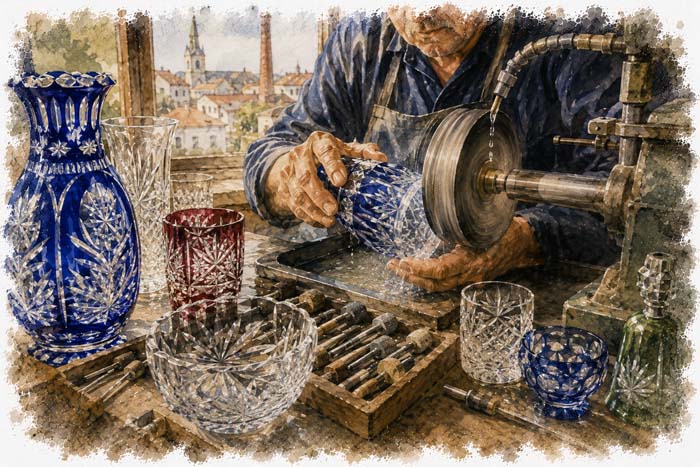
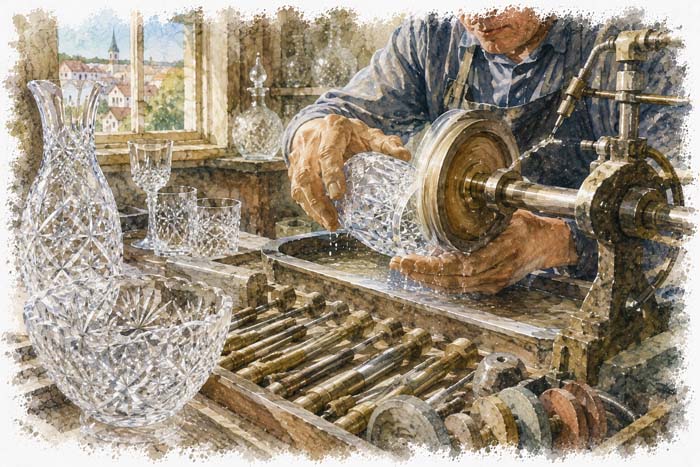
In the north, the historic centre of cutting, engraving, enamel painting and overlay work, and known to collectors by its German name Haida. It holds a glass museum, a glassmaking school and a cluster of working studios, and it hosts an international glass symposium that draws makers from across the world. A record from here should name the blower and the cutter separately and state whether the piece is potash or lead crystal, since the two behave differently in the hand and date differently.
Železný Brod
Further south, with its own glass school founded in the twentieth century and a distinct specialism: lampworked and figural glass, beads, and a strong line in modern studio work rather than the classic cut tableware of the north. It is the more contemporary of the two towns and the one where the school's influence on current practice is most visible. Records should say which technique, since the two towns are not interchangeable and the trade routinely treats them as though they were.
Kamenický Šenov
Minutes from Nový Bor and holding the oldest glassmaking school in the world, founded in 1856. That school is the reason the region's knowledge survived the expulsion of its German-speaking population after 1945, which removed most of the families who had held the trades. It teaches cutting and engraving still, and a serious cutter working anywhere in the valley has very often passed through it.
Jablonec nad Nisou
The bead and costume-jewellery town, German Gablonz, whose output was once exported worldwide and whose glass Christmas ornaments are still blown and silvered by hand. It is a different industry from the cut tableware of the other towns, built on pressed and lampworked glass at volume, and its beads sit upstream of beadwork traditions on several continents.
Also on the Map
Prague around 1600, where a gem engraver first took a wheel to glass. And the beech forests, whose ash is the reason any of this is hard enough to cut, and which the glassworks followed rather than the other way round. Town, blower, cutter, composition: four answers, and the name Bohemian on a label guarantees none of them.