Arts, Crafts and Living Ateliers
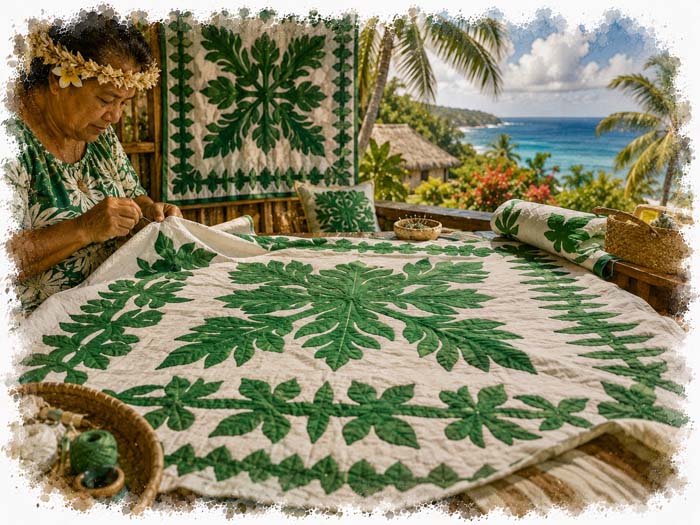
The work happens in a hall, a church room or a house, with several women around a large cloth, hand-sewing. Cutting is done flat on the floor. Because a tivaevae is bigger than any table, much of the making is conducted at ground level with the piece spread out, and the finished object is not seen whole and flat very often until the day it is presented and held up.
Reading a Tivaevae
Hand appliqué shows a turned edge stitched down with small, slightly irregular stitches, and the ground fabric can be cut away behind the applied shape or left, which is a maker's choice. Machine appliqué shows a satin-stitched edge of uniform width and tension. Look at the points and inner corners of a leaf or petal, which is where hand work shows control and machine work simply turns.
The Cut-in-One Kind
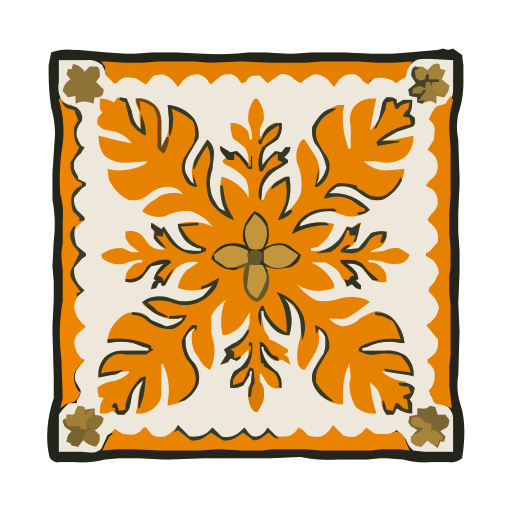
On the folded and cut type, check the symmetry. The whole motif is produced by folding the cloth into eight or more and cutting once, so the repeats are inherently identical, and any variation comes from the sewing rather than the cutting. That distinguishes it immediately from a composition built up from separately cut elements, where the repeats differ slightly. The two are frequently described with the same word.
The Back and the Quilting
Turn it over. Many tivaevae are unquilted, being a decorative top layer with a backing rather than a wadded quilt, and that is normal rather than unfinished. Where quilting exists, hand stitching shows small even running stitches that dimple the surface, and the reverse shows the same pattern. Look at the binding at the edge, which on careful work is even in width the whole way round.
Fabric and Fading
The materials are ordinary cotton, and that is the point rather than a compromise: the tradition uses bright commercial cloth bought at a shop. Colours fade in Pacific sun, so a piece kept folded and dark stays vivid while one used on a bed does not, and fading is a record of use. Modern polyester blends behave differently and are noticeably less pleasant to sew and to sleep under.
How Long, and Whose Time
A full tivaevae is months of group work, meeting perhaps weekly, and the labour is genuinely shared rather than divided. That has an economic consequence that explains the reluctance to sell: pricing one properly would mean pricing the time of six or eight women over half a year, which produces a figure no visitor expects and most would not pay. The alternative to a fair price is not a bargain, it is a gift given to the wrong person.
Ateliers, Villages and Artisan Encounters
Rarotonga is a small island circled by one road, reachable directly from New Zealand, and tivaevae can be seen at the national museum, in churches, and at the Saturday market in Avarua. Aitutaki and the outer islands hold their own groups. Because so much of the making is through church and community groups, meeting makers is a matter of asking locally rather than finding a workshop.
What Happens to Them
Because these are given, most tivaevae leave the maker's hands and enter another household's cycle of occasions, where they may be given on again, used until they wear, or held back for a funeral. A family accumulates them and knows which came from whom and for what. That biography is the object's real provenance, and it is almost never written down anywhere, which is exactly the gap this collection exists to close.
Tourwit Editions and Provenance
Tourwit commissions directly from tivaevae makers in Rarotonga and the outer islands, paying before work begins and leaving the major share of what a piece realizes with them, which means a group. The record names the women, the island, the design and its creator where that is established, states the type, and confirms hand appliqué. Where a maker says a piece should not be sold, that ends the matter.
Why These Works Matter
Here is a craft with a documented foreign origin, imported by missionaries as part of an effort to change how people lived, which the recipients took over completely and turned into the principal ceremonial object of their own culture. It is also one of the very few things in this collection that is deliberately not for sale, and the only honest thing a collection can do about that is say so plainly.