Arts, Crafts and Living Ateliers
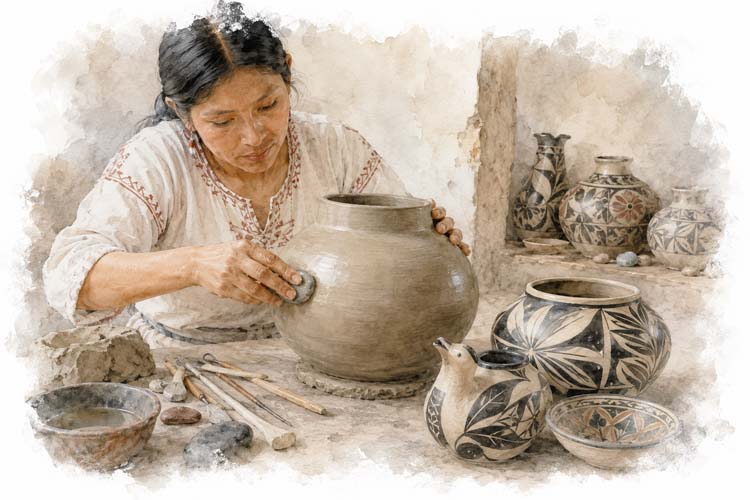
A Chulucanas workshop is a yard: clay drying, pots at various stages, a kiln, and a pit or chamber for the smoke firing with mango leaves stacked beside it. The paddling is done standing, rhythmically, over long periods, and the burnishing is done seated with a stone in the hand and a great deal of patience. The smoke firing is the event everything else waits for and it happens on a schedule set by the kiln rather than by anyone's preference.
Reading a Chulucanas Pot
Look at the boundary between black and pale. On genuine negative firing the edge is slightly soft and organic, because it is the limit of where smoke penetrated rather than a painted line, and the black has depth rather than sitting on the surface. Painted imitation has hard edges and a flat, opaque black. Feel the burnish, which should be a sheen in the clay body itself and not a varnish. And look at the wall thickness at the rim: paddled work is even and thin for its size, and slip-cast copies are not, being uniformly thick and noticeably heavier for their size.
Form, and What Is Actually Traditional
The characteristic contemporary shapes, the swelling closed forms and the rounded figures, are modern designs using an ancient method, and the workshops are open about this. Pieces that reproduce Vicús or Tallán vessel forms are a different category and should be described as reproductions rather than as antiquities, a distinction that matters because genuine pre-Columbian material from this valley exists and its trade is another matter entirely.
Why the Second Firing Sets the Price
Losses concentrate at the end. A pot that has already absorbed paddling, burnishing, drying, a kiln firing and the application of resist can still fail in the smoke chamber, and when it does the entire investment is gone. Workshops price accordingly, and a piece with perfectly even smoking across a large surface is a piece that survived the most dangerous stage cleanly. That evenness is worth looking for and worth paying for.
The Resist, and Where It Fails
The mask is the crux of the whole method. A clay slip is applied over the areas that must stay pale, and it has to adhere through handling and through the heat of a smothered firing without lifting, cracking or letting smoke creep beneath its edge. Where it fails, smoke reaches under and the pale field acquires a grey bloom. Look for exactly that on a piece being offered: a clean, confident boundary means the resist held everywhere, and a soft grey haze inside a pale area means it did not.
What Paddling Does That Throwing Cannot
A wheel-thrown pot is raised by pulling clay upward against centrifugal force, which limits how wide a form can swell relative to its opening. Paddling works the other way: the wall is thinned and pushed outward by compression between a paddle and a stone held inside, so a vessel can balloon far beyond its neck. That is why the characteristic Chulucanas forms are closed and swelling with small openings, shapes a wheel would struggle to produce. The method is not a primitive alternative to throwing. It does something throwing cannot.
Ateliers, Villages and Artisan Encounters
Chulucanas sits inland from Piura in the dry north of Peru, and the workshops are in and around the town, several of them well known and receiving visitors. The region is hot and the working day is arranged around that. Piura is the way in. Seeing a smoke firing is a matter of timing rather than of arrangement, since the firings happen when a load is ready.
Tourwit Editions and Provenance
Tourwit works directly with pottery workshops in Chulucanas rather than through intermediaries. Artisans are paid before the work begins and retain the major share of what a piece realizes. Editions are limited by what a kiln and a smoke chamber can carry, and each work is documented at source with its workshop, its maker and whether it carries the denomination of origin, so that the record travels with the object.
Why These Works Matter
Here is a craft whose decoration is made of absence: the pattern is what the smoke could not touch. The method is two thousand years old in this valley and sixty years old in these hands, recovered deliberately from the ground by people living on top of it. Owning a piece means owning both facts at once, and the honest description says both rather than choosing whichever is more flattering to the object.