Four Valleys
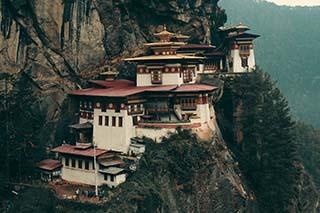
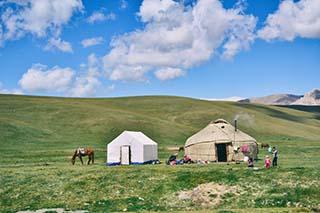
Bumthang is central Bhutan, four high valleys at around two and a half thousand metres, and it is the country's religious heartland: the temples where Buddhism first took hold in Bhutan are here, including one attributed by tradition to the seventh century and another built where Guru Rinpoche is said to have left the imprint of his body in rock. It is agriculturally marginal, cold, and grows buckwheat and barley rather than rice, which is itself a marker of altitude in this country.
The Thirteen Crafts
Bhutan formally codified its traditional arts as a set of thirteen, covering painting, sculpture, casting, carving, weaving, embroidery, papermaking, blacksmithing, woodturning and the rest, and teaches them in state institutes with a defined curriculum. That is unusual and worth stating plainly: most countries in this collection have crafts that survived despite the state, and this one has a government that enumerated them, built schools and issued a curriculum.
Painting Inside a Rule
Bhutanese thangka belongs to the same iconometric system as the Nepali and Tibetan traditions: proportions fixed by canonical measurement, a grid ruled before drawing, mineral pigment on a sized cotton ground, gold applied and burnished, the eyes opened last. The Bhutanese school sits within the Drukpa Kagyu tradition and has its own preferences in palette and in the treatment of landscape, but the measurements it works to are shared across the whole Himalayan world.
The Thongdrel
The giant festival banner is the form Bhutan is distinctive for. It is appliqué rather than paint, built from cut and stitched silk and brocade on a huge scale, and it is displayed once a year at dawn, unrolled down a monastery wall so that the crowd assembled below can see it and receive the blessing that seeing it is held to confer. It is rolled and stored before full daylight. The word means liberation on sight.
Yathra, Which Is Wool
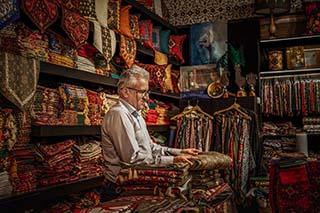
The other craft here is entirely domestic. Yathra is a woollen cloth woven in the Chhume valley from sheep wool, dyed and worked in strong geometric and floral bands, and made into blankets, jackets, cushion covers and the wraps that make a Bumthang winter survivable. Wool is unusual in Bhutanese weaving, which elsewhere runs to cotton, nettle and silk; this is a highland answer to a highland problem, and it does not appear in the lowland valleys at all.
The Patron Institution
The monastic body and the state, which in Bhutan are closely connected. Painting and appliqué serve the dzongs and monasteries directly, commissioned for religious purpose and maintained by them, and the crafts institutes are government. Yathra had no patron at all: it was household weaving for household use and local trade, and it has become a commercial product only in recent decades, sold along the road through Chhume.
National Dress and Its Effect
Bhutan requires traditional dress, the gho for men and the kira for women, in formal and official settings. Whatever one makes of that as policy, its effect on textiles is unambiguous: it sustains a continuous domestic demand for woven cloth that no heritage programme could manufacture. Weaving in Bhutan is not a revival or a visitor trade; it is what people are wearing to work today.
Appliqué Rather Than Paint
The technique of the big banners deserves setting out because it is not painting scaled up. The design is drawn full size, the shapes are cut from coloured silk and brocade, edges are turned and couched down with cord, and figures are built from many separate pieces stitched onto a ground, sometimes with padding beneath to raise them. Silk holds colour brilliantly and reads at a distance, which paint on that scale would not, and the whole thing rolls without cracking.
Where It Stands
Both crafts are in genuinely good health by the standards of this collection. Weaving is widespread and economically significant for rural women, painting is taught formally and practised for a real religious client, and Bhutan's controlled approach to tourism has limited the volume of cheap imitation that swamps comparable places. The scarce commodity here is not skill but time and the number of trained hands available in a country of under a million people.