Arts, Crafts and Living Ateliers
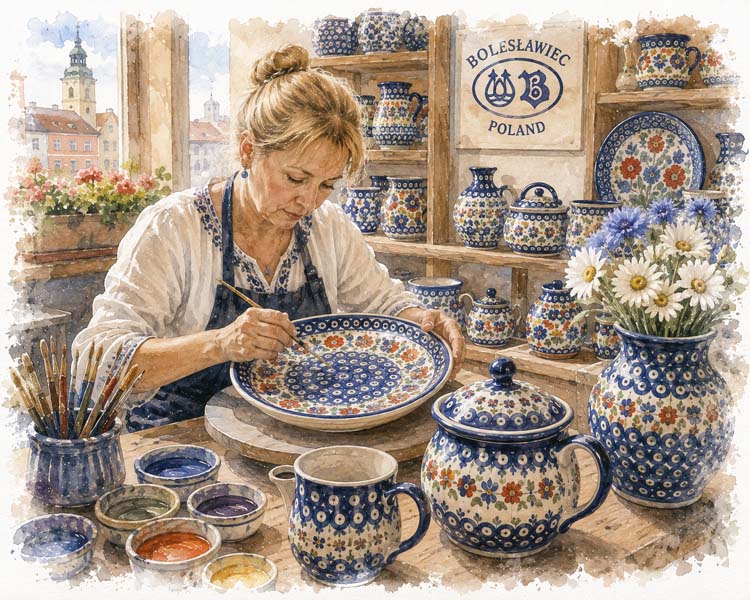
The workshops are industrial in scale but the decorating is not. Pieces are formed by throwing, jiggering or casting, dried, and then passed to decorators who sit with trays of cut sponges and colour and work the pattern round the form by hand. The sponges wear out and are recut. The rhythm is quick and practised, and watching a decorator cover a large bowl in a few minutes is the fastest way to understand both the skill and why the ware remains affordable at the standard grades.
Reading a Bolesławiec Piece
Look closely at repeated motifs. Hand-stamped marks vary in ink density and in exact position: some are heavier, some slightly rotated, some overlap a neighbour, and the pattern adjusts where it meets a handle or a curve. Screen-printed imitation repeats identically and its pattern runs under handles without accommodation. Under a glass, a print shows a dot screen; a sponge impression shows the irregular open texture of the sponge itself.
The Body and the Base
Turn the piece over. Genuine stoneware is heavy for its size, and the unglazed foot ring should be dense and slightly gritty rather than chalky or porous. Tap it: stoneware rings. The base carries the manufactory mark, usually stamped or printed, and better pieces carry a decorator's initials or signature and a pattern number. A piece with no mark at all, sold as Polish pottery, is a piece with nothing standing behind it and quite possibly nothing to do with the town.
Grade, Signature and Price
The graded system is unusually transparent for a craft and it is worth using. Standard sponge-stamped work is the everyday tier. Above it, pieces combining stamping with hand-painted detail. At the top, largely hand-painted pieces, frequently signed, sometimes numbered, and priced accordingly. Ask which grade a piece is and who decorated it, because both are usually recorded and both are usually withheld unless requested.
What It Is Actually For
This is the rare craft in this collection designed to be used hard. It is oven-safe, dishwasher-safe and microwave-safe because a vitrified body and a fitted glaze can take thermal shock, and the traditional forms are baking dishes, casseroles, jugs and mugs rather than display pieces. Treating it as ornament is a category error. It was made to go into a hot oven and to be scrubbed afterwards, and a piece kept on a shelf is being denied the only thing it was designed for.
Cutting the Sponge
The tool is made by the decorator. A natural sea sponge is trimmed with a blade to the required shape, and its open irregular texture is what leaves the characteristic broken, slightly mottled mark rather than a solid block of colour. Sponges compress and wear with use, so the same tool prints differently over its life and is eventually recut or replaced. That is why two pieces in the same pattern from the same works are never quite identical.
Ateliers, Villages and Artisan Encounters
Bolesławiec is a small town roughly between Wrocław and Dresden, and several manufactories operate there with shops and workshop tours. The town holds a large ceramics festival each summer that brings the works together and is the practical moment to compare grades and meet decorators. The town museum covers the older Bunzlau brown stoneware, which is where the history actually starts.
Tourwit Editions and Provenance
Tourwit commissions directly from Bolesławiec manufactories and decorators, paying before work begins and leaving the major share of what a piece realizes with the maker. The record names the decorator and the manufactory, states the grade, confirms the decoration is hand-stamped or hand-painted rather than printed, and gives the pattern. It also states the tradition's history honestly, including the post-1945 discontinuity.
Why These Works Matter
Here is a pottery that has no court behind it, was never precious, and was designed to be put in an oven, and it has outlasted several traditions that were all three. It also carries an uncomfortable history that most accounts skip: the place kept making this ware after the people who made it were expelled. Recording the decorator's name now is a small correction to a craft whose continuity has already been broken once.