Farms With Long Winters
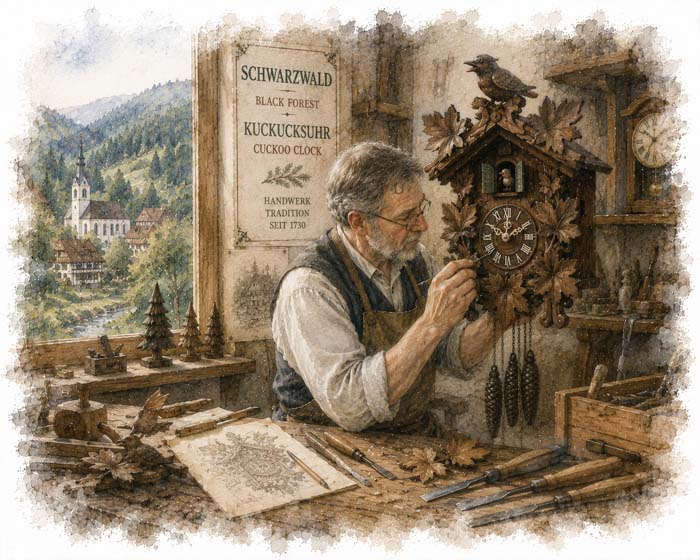
The Black Forest is high, wooded and snowbound for months, and its farms could not work the land through winter. What they had instead was time, timber and a tradition of woodworking. Clockmaking began here in the second half of the seventeenth century as a winter occupation, with movements cut entirely from wood, and it spread from farmhouse to farmhouse because it needed no forge and almost no capital, only a knife, a saw and patience.
Wooden Wheels
The early Black Forest clocks are remarkable objects: the frame, the wheels, the teeth, the arbors, all cut from wood, driven by stone or iron weights on cords, with only a few metal parts where wear made them unavoidable. They were cheap enough for ordinary households across Europe to own a clock for the first time, and that is the industry's real historical significance. It democratised timekeeping from below, while Switzerland was refining it from above, which is the contrast that makes these two heartlands a pair.
The Peddlers
Distribution was the genius of it. Black Forest clock peddlers carried stacked clocks on wooden frames on their backs and walked them across Europe and beyond, into Russia, the Ottoman lands, England and eventually the Americas, selling and repairing as they went. Whole villages specialised in the trade. The region built an export industry with no port, no river and no road worth the name, on foot. At its height the trade supported thousands of walking salesmen, and their routes are documented in the museum at Furtwangen.
The Shield Clock and the Painted Dial
Before the chalet there was the shield clock: a flat painted wooden board, arched or scalloped at the top, carrying the dial and hiding the movement behind it, hung straight on a wall with the weights and pendulum in the open beneath. The boards were painted with flowers, birds and figures by specialists, frequently women, and they are the authentic Black Forest domestic clock of the eighteenth and early nineteenth centuries. Almost nobody outside the region recognises one.
The Patron Institution
The state, and unusually late. There was no guild and no court behind this. When cheap American and later Asian competition threatened the industry in the nineteenth century, the Grand Duchy of Baden responded institutionally: it founded a clockmaking school at Furtwangen in 1850 under Robert Gerwig, to teach standardised methods, improve design and organise the trade. The school, and the museum that grew from its teaching collection, are still there.
The Competition of 1850
Gerwig's school ran a design competition for a new case, and the winning idea came from Friedrich Eisenlohr, an architect who had designed station buildings for the Baden railway. He proposed adapting the railway guard's house, a small pitched-roof lodge with a decorated gable, into a clock case. Carvers added foliage, game and eventually the bird, and within decades that shape had become the international shorthand for the region. It is a nineteenth-century invention with a documented author.
How the Cuckoo Works
The call is made by two small bellows, each sounding a single wooden pipe tuned a third apart, operated by the movement so that the two notes fall in sequence. It is a genuine acoustic reproduction of a bird call rather than a recording or a reed, and the mechanism dates from the eighteenth century, well before the chalet case. A clock that produces the call electronically is a different object regardless of what its case looks like, and it should be described as one.
The Music Boxes and the Orchestrions
The same region built the mechanical music trade, and at scale. Black Forest workshops produced cylinder and disc music boxes, and then the orchestrions: large automatic instruments with pipes, drums and reeds driving a whole ensemble from a punched roll, made for inns, fairgrounds and dance halls across Europe and America. They are the most ambitious machines the region ever built and the museum at Furtwangen keeps working examples, which are worth hearing rather than reading about.
Where It Stands
The industry contracted hard through the twentieth century under competition from cheap quartz movements and imported imitations, and a great deal of what is sold as a Black Forest cuckoo clock is neither mechanical nor German. A regional association now certifies genuine locally made mechanical clocks, which is the only reliable guide. What survives is a smaller trade making real movements, alongside the school, the museum and a very large amount of imitation sold under the region's name.