Arts, Crafts and Living Ateliers
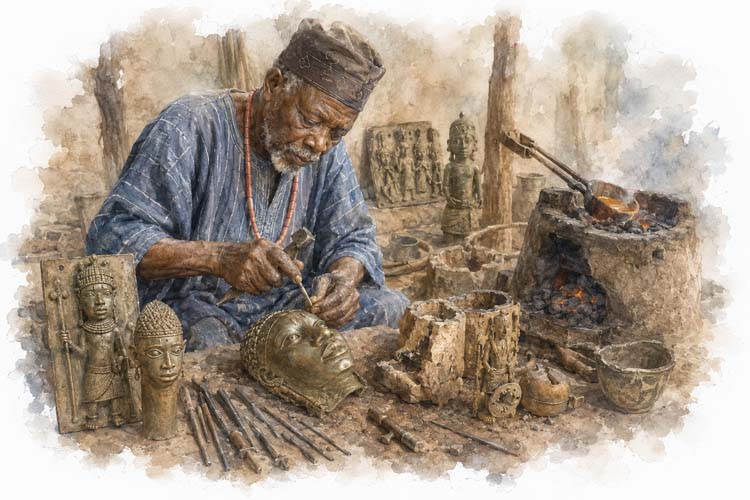
Brass casting continues in Benin City, in the quarter historically associated with the founders' guild, using the lost-wax method: a model in wax, invested in clay, heated so the wax runs out, filled with molten metal, and broken open. The work is hot, communal and staged, with several people to a pour. What a visitor sees is a working trade producing new objects, not a demonstration of a dead one.
What the Old Plaques Actually Do
The historic plaques are worth understanding as documents. They depict the Oba, his chiefs, his warriors, court officials, Portuguese traders in their own dress, and the regalia and ceremonies of the palace, at a level of specificity that lets a viewer read rank, role and period from clothing and attribute. They were mounted in the palace where they could be consulted. A dynasty that did not write its history in books wrote a great deal of it in relief on brass.
The Standard the Guild Worked To
Technically these are among the most accomplished castings produced anywhere before the modern period. Wall thicknesses on the finest plaques are extremely thin and remarkably even, which in lost-wax work means the wax model was made thin and even and survived investment and firing without distortion. Sixteenth-century European visitors recorded their surprise at the quality. That technical fact is worth stating because the material was long presented in Europe as ethnographic rather than as art, a categorisation that the objects themselves refute on inspection.
Contemporary Work and Honest Description
The casting made in Benin City today is contemporary work in an inherited technique, and the good workshops describe it that way. Copies of famous museum pieces are made and sold openly, which is legitimate when described as reproduction. What is not legitimate is the trade in objects presented as antique, and any pre-twentieth-century Benin material offered privately should be assumed to have a problem until proven otherwise, because the documented route by which such objects left the city is the 1897 expedition. There is effectively no innocent explanation available for an old Benin plaque in private hands.
Reading a Cast Piece
On any piece, look at the surface for the marks of the process: lost-wax casting leaves evidence of the wax model in the finish, and chasing after the pour shows as tool work rather than as mould seams. Sand-cast and machine-finished reproductions are flatter and more regular. Weight and alloy matter, since brass, bronze and modern alloys differ. And ask the workshop directly what a piece is: a reproduction of a known plaque, a new composition in the tradition, or something represented as old.
What a Reproduction Is Worth
Reproductions occupy an honest and useful place here. A well-cast copy of a famous plaque, made in Benin City by a caster whose predecessors made the original, is a legitimate object with a clear line to the tradition, and it is the only way most people will ever hold something of this kind. It should be priced and described as what it is. The dishonesty in this market runs entirely in one direction: nobody passes off an original as a copy.
Ateliers, Villages and Artisan Encounters
Benin City is the place, and the casting quarter is the part of it that matters for this craft. The Edo museum project, developed to receive returned material, is reshaping how the city presents this history. Anyone visiting for the craft should understand they are arriving in the middle of an active and unfinished argument about where these objects belong, and that local views on it are not uniform.
Tourwit Editions and Provenance
Tourwit works directly with brass casting workshops in Benin City rather than through intermediaries. Artisans are paid before the work begins and retain the major share of what a piece realizes. Editions are limited by what a pour can produce, and each work is documented at source with its workshop, its caster, its alloy and an explicit statement that it is contemporary. No historic Benin material is handled, offered or brokered under any circumstances.
Why These Works Matter
This collection asks, on every card, how an object left the people who made it. Benin is where that question is being answered in public by national governments and major museums, at a scale that makes evasion impossible. The city's casters are still working while a large part of their predecessors' output sits in glass cases in other countries and slowly, unevenly, comes home. Nothing else in these pages states the stakes of provenance so plainly, and nothing else makes the cost of getting it wrong so visible.