Arts, Crafts and Living Ateliers
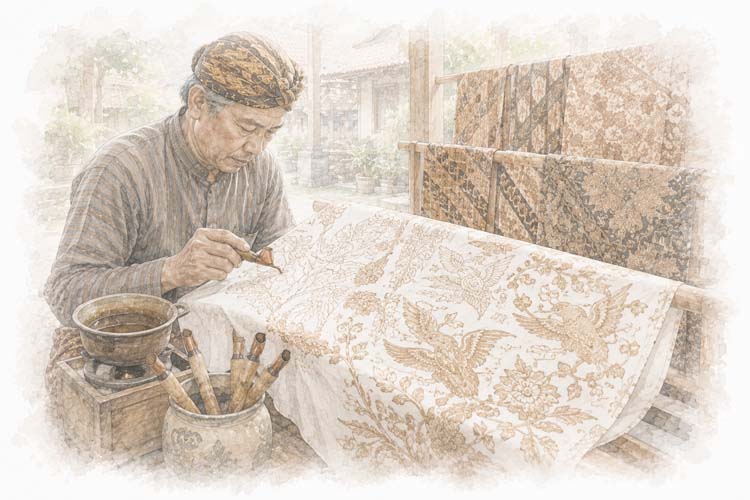
A batik workshop is a low table, a stretched length of cotton, a small stove keeping wax molten, and a canting, the copper pen with a fine spout through which wax flows like ink. The worker sits with the cloth across her knee and draws. In the stamping workshops the tool is a cap, a carved copper block dipped in wax and pressed, and the working sound changes completely from silence to a rhythm. To move through central Java is to find two production cultures in one craft. What is made here is not printed fabric; it is a cloth from which something was removed to leave a pattern behind.
Tulis and Cap, and Why It Matters
Batik tulis is drawn by hand with the canting, one line at a time, and a fine piece takes months. Batik cap is stamped with the copper block, which is far quicker and still genuine batik, since the wax is still applied and boiled out. The two are frequently sold as though they were the same thing and they are not remotely equivalent in labour. The test is on the reverse: hand-drawn work penetrates and shows almost as strongly on the back, and the line has small irregularities of pressure. A stamped piece repeats exactly at the block's interval, and a printed imitation, which is not batik at all, is weak on the reverse entirely. That one check settles most of what a buyer needs to know before any discussion of motifs.
The Sequence of Waxings
Colour is built by repetition. Wax reserves what must stay pale, the cloth is dyed, the wax is boiled off, fresh wax reserves what must keep that colour, and the cloth goes into the next dye. A traditional three-colour piece in the classic soga palette of indigo, brown and cream has been waxed, dyed and de-waxed several times, and each cycle risks everything already achieved. This is why the number of colours in a batik is a proxy for its cost and why the classic court pieces stay within a narrow palette worked to extraordinary refinement rather than reaching for range. Restraint here is a consequence of risk, not of taste alone.
Court Palette and Coastal Palette
Two aesthetics run side by side. The inland courts of Yogyakarta and Surakarta favour restraint: indigo, soga brown and undyed cream, dense geometric repeats, symmetry and philosophical reference. The north coast at Pekalongan and Cirebon, exposed to Chinese, Arab, Indian and Dutch trade, developed a brighter and more pictorial batik with looser composition and a much wider palette. Neither is a degraded version of the other. A collector should identify which world a piece belongs to before judging its colour, because the criteria are opposite. Court work is judged by how much it withholds and coastal work by how much it carries.
Ateliers, Villages, and Artisan Encounters
The craft is met at the table, and the stage worth watching is the de-waxing, when a stiff, dull, wax-covered cloth goes into boiling water and comes out as the thing it was always going to be. Everything before that is deferred. Sitting beside someone drawing a canting line she will boil away next week changes what acquiring means. Provenance stops being a document and becomes a count of waxings, each one a chance to lose everything before it.
Tourwit Editions and Provenance
Tourwit works directly with Javanese batik workshops rather than through intermediaries. Artisans are paid before the work begins and retain the major share of what a piece realizes. Editions are limited by the wax and dye cycle, which cannot be compressed, and each work is documented at source with its workshop, its maker, whether it is tulis or cap, and its number of colours, so that the record travels with the cloth.
Why These Works Matter
To bring home a Javanese batik is to acquire a cloth that once stated a legal position. The pattern may have been reserved by decree, its permitted scale fixed by rank, and its use by the wrong person an offence. The wax that made it was entirely removed before anyone saw the result. And a hand-drawn piece is months of a person holding a copper pen steady enough that the line does not thicken. The work exists because two courts decided that what a person wore should be a matter of law.