Arts, Crafts and Living Ateliers
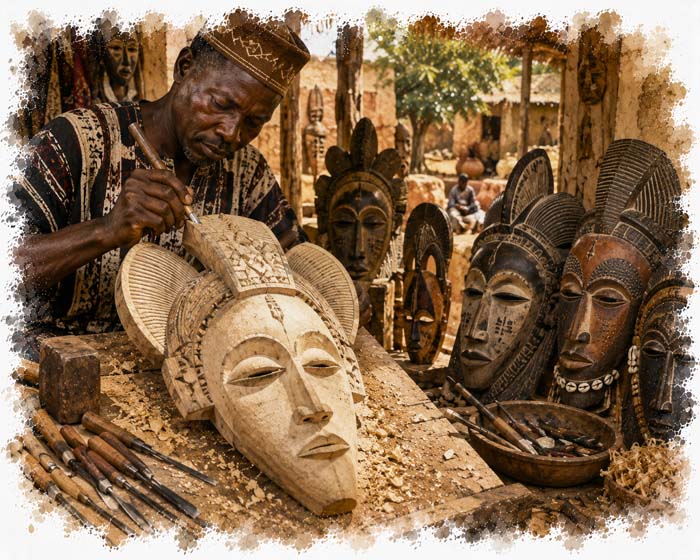
The carving is done in wood, worked green and then dried, with an adze for the rough form and knives and chisels for the finish, and the surface is then smoothed, blackened and oiled. A commissioned figure takes a specialist carver a matter of weeks. The workshops producing for the market operate differently, at volume, and the difference between a commissioned object and a produced one is visible in how much attention the back and the underside received. Nobody hurries a figure that a client will live with.
Reading a Baoulé Figure
Go to the face first: the eyes, the mouth, the scarification on the temples and the elaborately dressed hair are where a good carver spent his time, and the modelling should be assured rather than merely neat. Then look at the surface. A figure that was owned and handled shows wear concentrated where hands held it, an oiled depth that goes into the wood rather than sitting on it, and offerings absorbed into the surface. Artificial ageing sits evenly across the whole object because it was applied rather than acquired.
The Feet and the Back
Two places betray production work. The feet and base of a genuine figure are finished properly because the object stood and was handled, while volume work frequently leaves them perfunctory. The back and the underside get real attention in a commissioned piece and almost none in a piece made to be seen from the front in a shop. Turn everything over. It is the single most useful habit in assessing sculpture from this region, and it takes two seconds.
The Honest Position on Age
The market for old Baoulé sculpture is difficult and the fakes are good. The realistic options are these: acquire new work from a named living carver, described as new, which is straightforward and supports the tradition; or engage with old material only through documented collection history, which is expensive and rare. What should not happen is acquiring something of uncertain age with a confident story attached, since that combination is exactly what the production industry exists to supply, and the story is the cheapest part of it to manufacture.
The Coiffure
Hair is where a Baoulé carver shows what he can do. The figures wear elaborate dressed coiffures built into the carving in plaited and coiled registers, sometimes with a crest, and they record actual hairstyles of the period in which the figure was made. That makes the hair useful as well as beautiful: it is a dating and attribution clue, since styles changed, and it is a place where volume work simplifies first because it is the most time-consuming area on the piece.
Ateliers, Villages and Artisan Encounters
Baoulé country is the centre of Côte d'Ivoire, with Bouaké as its principal city and the carving spread through the surrounding towns and villages. Bouaké's market is a major regional one. Carvers can be met and commissioned directly, and the country's other sculptural traditions, the Dan masks to the west and the Senufo work to the north, are within reach and are separate traditions rather than variants of this one, with their own materials, institutions and criteria. Confusing them is the most common error made about Ivorian sculpture.
Tourwit Editions and Provenance
Tourwit commissions new work directly from Baoulé carvers, paying before work begins and leaving the major share of what a piece realizes with the carver, and every record names him, the town, the wood and the date of carving. Nothing is offered as old. Figures that were owned and used, and masks belonging to restricted institutions, are outside what this collection handles, and the reason is that neither category has an honest route to a market.
Why These Works Matter
A tradition of intimate portrait sculpture, commissioned by individuals from named specialists for private use, is rare anywhere and it produced some of the most refined carving in West Africa. It has also been more thoroughly stripped and more skilfully imitated than almost any other. The useful response is not to chase the old work but to commission the living carvers, name them, and let the record start clean for once, on objects whose history begins with a name rather than with a gap.