The Plain of Temples
Bagan on the Irrawaddy was the capital of the first unified Burmese kingdom from the ninth to the thirteenth centuries, and it built temples on a scale that has few parallels: thousands of brick monuments across a plain, of which a large number survive. The kingdom fell to Mongol pressure and the city declined, but the site remained a religious centre and the craft traditions attached to it outlived the court by seven centuries.
What Yun Is
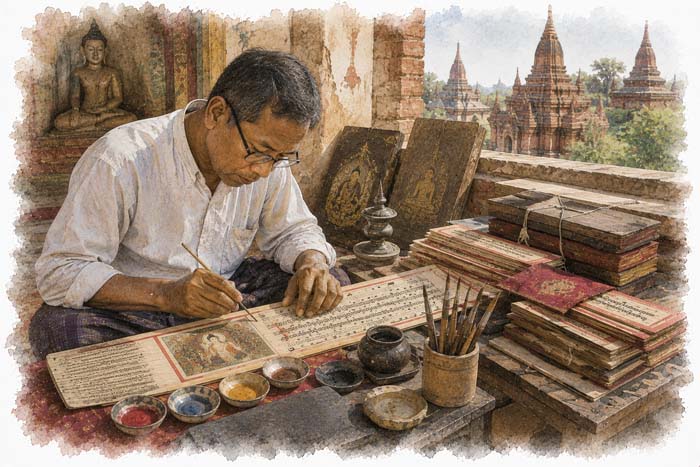
The engraved technique has its own name and it is the tradition's signature. A cured black lacquer surface is incised freehand with a fine metal stylus, the incisions filled with a coloured lacquer that is worked into the cuts, and the surface then polished back so colour survives only in the engraved lines. Each additional colour requires the whole cycle again: engrave, fill, cure, polish. A four-colour piece has been through the whole sequence four times, with the registration holding each time.
The Core Beneath
The quality of a Burmese lacquer object is decided by what is under the lacquer. Ordinary pieces are built on bamboo strips coiled or woven into a form. The finest are built on a lattice of split bamboo woven together with horsehair, which produces a wall thin enough and elastic enough that a finished bowl can be flexed until opposite sides of the rim meet, and will spring back. That flexibility is the traditional test and it is genuinely startling the first time it is demonstrated.
Layers and Time
The core is coated in successive layers of lacquer mixed with ash or bone powder, each cured and rubbed down, building a surface that is smooth, hard and independent of the weave beneath. A serious piece carries many coats over months, cured in humid cellars exactly as in Korea, because the same material behaves the same way. Speed is the enemy of every stage.
The Patron Institution
The monasteries and the court, and then the household. Lacquer served Buddhist practice directly: offering vessels, manuscript chests, the gilded and glass-inlaid containers for palm-leaf texts, and the alms bowls and food carriers of monastic and domestic life. It was also everyday tableware in a country where lacquer was to Burma what pottery was elsewhere, light, unbreakable, repairable and safe for hot food.
Gold and Glass
Beyond engraving there is shwezawa, gilding on lacquer, in which a design is drawn in a resist, gold leaf is applied over the whole surface and the resist washed away so gold remains only where it is wanted. There is also relief moulding in a lacquer putty, and the glass-mosaic inlay that covers monastic furniture and thrones in glittering fields of cut mirror. These are separate specialisms within the same workshops.
The Manuscript Chests
The most elaborate lacquer this tradition produced was made for texts. Palm-leaf manuscripts were kept in chests and wrapped in bindings, and both were treated as objects of merit in their own right: gilded, inlaid with cut glass and semi-precious stone, moulded in relief, and lettered. A donor paid for the copying of a text and for the container that held it, and the container was frequently the more expensive item.
Where It Stands
Bagan remains the centre and lacquer is made there in quantity, with a government lacquerware school and museum in New Bagan and workshops throughout. The range runs from genuinely fine horsehair-cored engraved work by named masters down to quick pieces in synthetic lacquer over cheap cores made for the visitor trade. The 2016 earthquake damaged many temples and the site was inscribed by UNESCO in 2019.
Where the Lacquer Comes From
The sap is tapped from a tree that grows in the forests of upper Myanmar and Shan State rather than around Bagan itself, so the raw material travels to the workshops. It is collected in the wet season by cutting the bark and catching what runs, filtered, and stored under conditions that keep it from curing prematurely. As everywhere it works with lacquer, it is a severe irritant while raw, and workers develop tolerance or find another trade.
The Honest Difficulty
Myanmar's situation since 2021 has been severe, with conflict, economic collapse and a collapse in visitors, and craft economies dependent on that trade have suffered accordingly. Anyone acquiring from here should understand that the ordinary mechanisms of commissioning, payment and travel are not straightforward, and should take more care rather than less that payment reaches the maker directly.