The Word and the Origin
The name derives from an Arabic term for polished stone, and the earliest tiles used in Portugal were imported from Seville in the Hispano-Moresque manner: small geometric pieces, frequently with the colours separated by raised ridges or incised lines to stop them running together in the firing. King Manuel I bought quantities of these in the early sixteenth century for his palace at Sintra, and they are still there. At that stage this is an Iberian Islamic tradition arriving in Portugal, not a Portuguese one.
Italian Technique, Portuguese Appetite
The change came when the Italian maiolica method reached the peninsula in the sixteenth century. Painting directly onto a flat white tin glaze removed the need to separate colours mechanically, which meant a tile no longer had to be a self-contained unit: a picture could now run across dozens or hundreds of tiles as a single continuous image. That is the technical unlock, and Portugal exploited it more thoroughly than anywhere else in Europe.
Why Blue on White
The seventeenth century brought Chinese blue-and-white porcelain to Europe in enormous quantity through the maritime trade, and Delft in the Netherlands built an industry imitating it. Portuguese taste followed, and by the late seventeenth and eighteenth centuries the great narrative schemes are overwhelmingly cobalt blue on white. It is a fashion with a traceable cause rather than a permanent national preference, and earlier Portuguese tile is far more polychrome, in yellows, greens and manganese purples that the blue-and-white period pushed aside.
The Golden Age
The high point runs roughly from the late seventeenth century into the eighteenth, when named masters produced vast figurative cycles for churches, convents and palaces: biblical narratives, hunting scenes, battles, allegories, framed in painted architecture and running the full height of a nave. This is the period that makes Portuguese tile distinct in Europe, and it coincides with the gold flowing in from Brazil, which paid for a great deal of it. Several of the masters of this period signed their work, so the golden age is one of the few stretches of this tradition where the painter's name survives.
How a Wall Is Painted
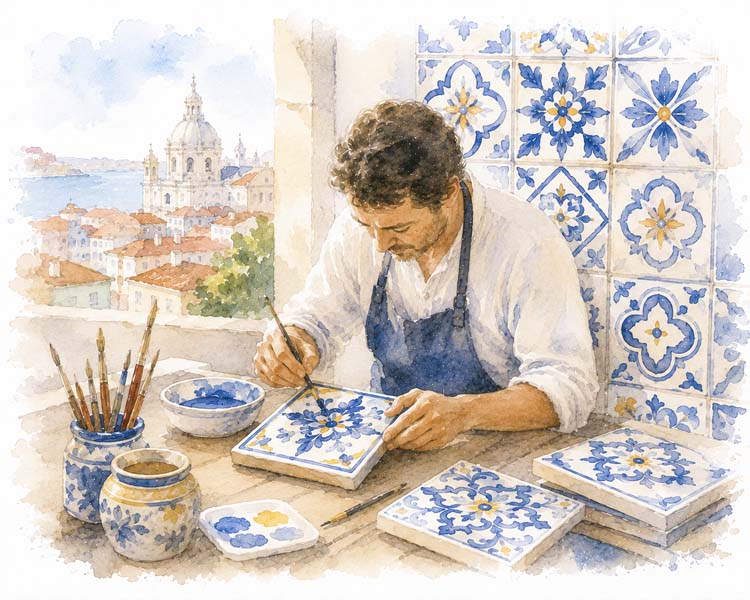
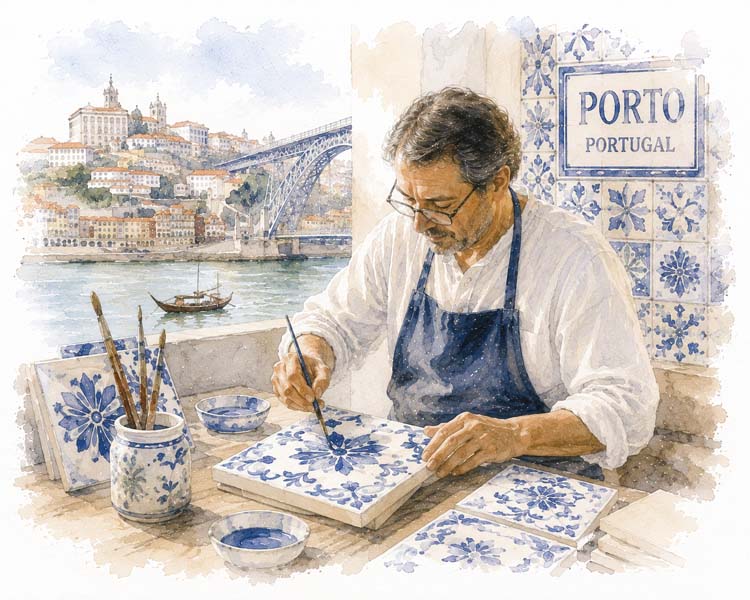
A narrative scheme is designed as one image and then divided. The full-size drawing is made on paper, its lines pricked through, and charcoal dusted through the holes onto the glazed tiles so each carries its fragment of the composition. The painters then work tile by tile, in oxides on the dry glaze with no possibility of correction, and every tile is numbered on the reverse so the wall can be assembled in the right order. A single error is a tile remade, not a line repainted.
The Patron Institution
The Church, the crown and the nobility, and later, unusually, the state and the public. When the earthquake of 1755 destroyed much of Lisbon, tile was used extensively in the reconstruction because it was durable, washable and could be produced in standardised quantity, which shifted the craft toward pattern work and building material. In the twentieth century the metro system commissioned major artists to tile its stations, which is patronage of a genuinely modern kind.
Two Cities, Two Registers
Lisbon is where the court, the great convents and the reconstruction were, and it holds the largest concentration of historic narrative schemes as well as the national tile museum in a former convent. Porto's identity is different and later: its most famous work is the monumental blue-and-white cladding of the early twentieth century, covering church exteriors and the railway station in enormous historical scenes. One city is the golden age; the other is the great revival, and confusing the two is the commonest error made about Portuguese tile.
Decline, Revival and Theft
The nineteenth century industrialised the craft and much output became repetitive facade tiling, still handsome but no longer painted individually. A serious revival came in the twentieth century through artists and through public commissions. The current threat is theft: tiles are stripped from the facades of derelict and unguarded buildings and sold, and both cities have brought in restrictions on removing them. That is directly relevant to anyone offered old Portuguese tiles loose, and it is the single most important thing to know before acquiring anything from this tradition.