Three Islands in the Atlantic
The Arans lie across the mouth of Galway Bay, three limestone islands of bare rock and stone walls where soil had to be made by hand from sand and seaweed. It is Irish-speaking country with a fishing and small-farming economy and a long history of poverty and emigration. The landscape is spectacular and it is spectacular because almost nothing grows there without extraordinary human effort, which is worth remembering when the knitwear is described as ancient.
Where the Legend Came From
The clan-pattern myth has a traceable route. Synge's play Riders to the Sea, written after he spent time on the islands, has a drowned man identified by stitches in a knitted stocking. A 1930s and 1940s enthusiasm for Irish folk culture picked the idea up, and a 1948 book of Aran patterns and later commercial promotion codified it into the claim that specific patterns belonged to specific families. No documentary evidence supports that, and the pattern books themselves are the earliest source for most of it. The islanders were not consulted about their own tradition until after it had been written down for them.
What Actually Happened
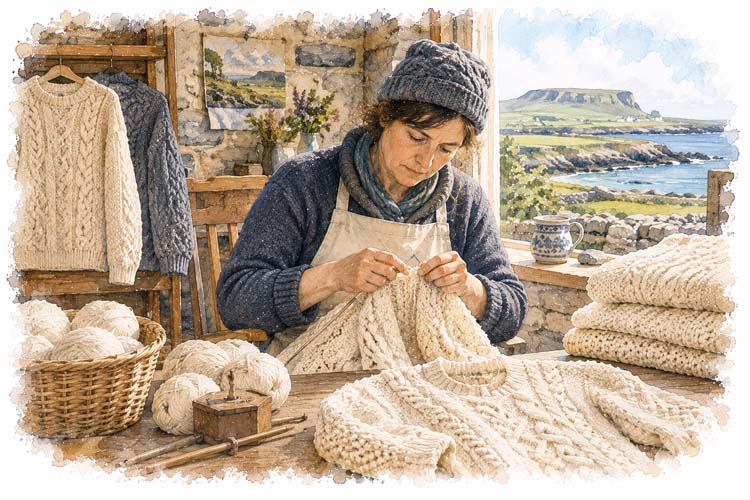
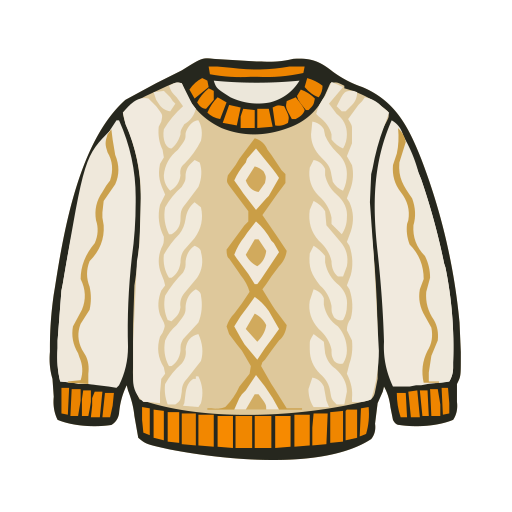
Knitting for sale developed on the islands in the early twentieth century, encouraged by organisations promoting rural industry in the west of Ireland, and the heavy cream cable sweater took its recognisable form somewhere between the 1900s and the 1930s. Earlier island knitwear was plainer and usually indigo-dyed. The elaborate stitch repertoire is real and is genuinely local, and it is not ancient. Both things are true at once.
Knitting in the Round, and Why It Is Not
A technical point that separates this from its Icelandic pair. The Aran sweater is knitted flat in pieces, front, back and sleeves, and then seamed, which is what allows the great vertical panels of cabling to be worked and mirrored precisely across the body. The cables themselves are made by holding a group of stitches on a spare needle while the neighbouring group is worked, then knitting them out of order so the columns cross. Every crossing is a deliberate interruption.
The Patron Institution
Not a court and not a guild, but development organisations and then the market. Rural industry schemes supplied wool and bought finished work, and from the middle of the century a deliberate export effort took the sweater to America, helped by a 1950s magazine feature and by the Clancy Brothers wearing them on stage. Within a decade an island cottage industry had become an internationally recognised garment. The promotion was extremely effective and the legend was part of it.
The Stitches
The vocabulary is worth knowing because it is the actual content. Cables read as ropes and are the signature. Diamonds, honeycomb, moss or blackberry stitch, basket, trellis, zigzag and the tree of life recur, combined in vertical panels that run the length of the garment and are mirrored across it. Each has been assigned a meaning in the literature, ropes for fishermen's lines, honeycomb for the hard-working bee, and those readings are twentieth-century attributions rather than island tradition.
Báinín and the Lanolin
The classic sweater is undyed cream wool, and the historic yarn retained much of its natural grease, which made the garment substantially water-repellent and is the practical reason a fisherman would wear one. Modern yarn is generally scoured, softer and less weatherproof. The unbleached colour is not an aesthetic decision either; it is simply what the wool was before anyone spent money dyeing it.
The Fisherman Who Would Not Have Worn It
One further correction, because it is load-bearing. A heavy cabled sweater is warm, bulky and slow to dry, and the working garment of the Atlantic fisherman was more often a close-fitting plainer knitted gansey, dark, tight and hard-wearing, of the kind made all round the British and Irish coasts. The elaborate cream Aran is closer to a garment for shore and for Sunday than to working kit, and the imagery that surrounds it inverts that.
Where It Stands
Hand-knitting on the islands continues at a small scale, and there are knitters producing genuine hand-worked sweaters to commission. The overwhelming majority of Aran sweaters sold anywhere are machine-knitted, many of them outside Ireland entirely, and the price difference between the two is very large. Neither is a scandal. What matters is that the label frequently does not distinguish them and the buyer is left to, and usually is not told which they are holding.