Tin, and What It Solved
Ordinary earthenware fires to a porous buff or red. Adding tin oxide to a lead glaze turns it opaque white, which gives a potter a clean ground to paint on, and that single chemical trick is the foundation of an entire family of European ceramics. It reached Spain through the Islamic world, which had developed it centuries earlier, and Spanish tin-glaze became the parent of Italian maiolica, Dutch delftware and everything downstream. Talavera sits close to the source of that line.
The Sixteenth-Century Rise
Production here became significant in the sixteenth century and reached its height in the seventeenth, supplying the Spanish court, the religious houses and the aristocracy with tableware, apothecary jars, tiles and large decorative pieces. The monarchy's patronage was direct, and Talavera tile schemes were installed in palaces, churches and monasteries across Castile. The town's name became the general Spanish word for this kind of pottery, which is why it later attached itself to a colonial city on the other side of the Atlantic.
Painting on Raw Glaze
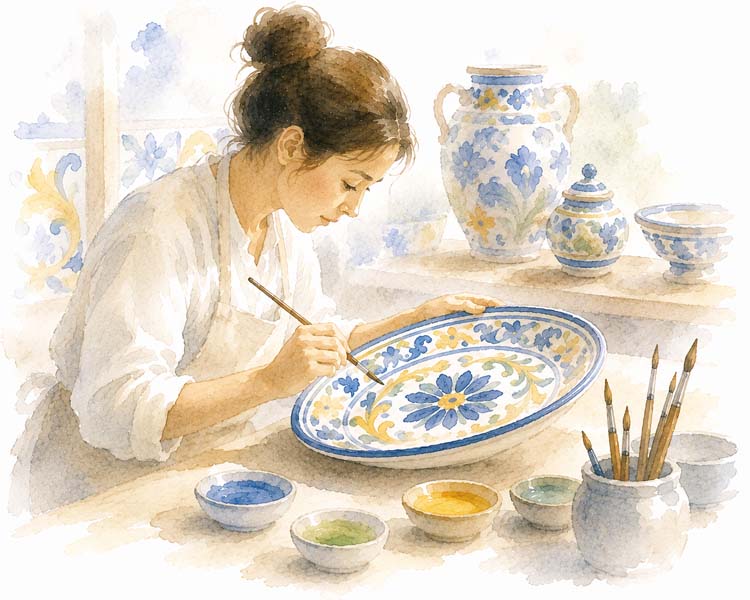
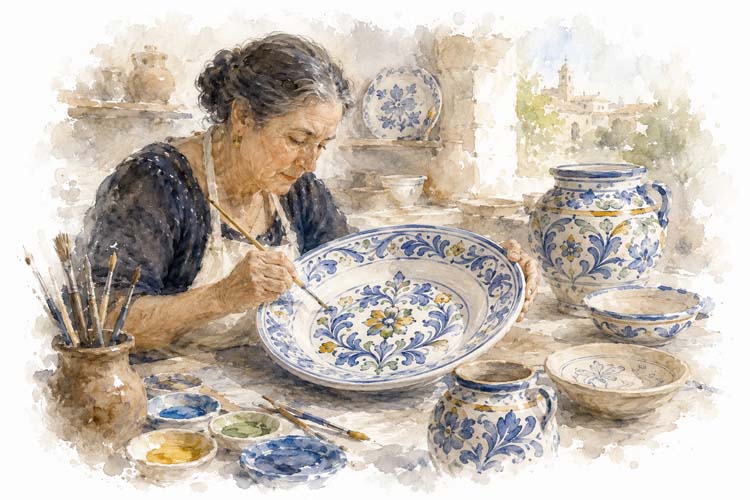
The demanding part is that the decoration is painted onto the unfired glaze, which is a dry powdery surface that absorbs pigment instantly like a sponge. The brush cannot be dragged, a line cannot be corrected, and a hesitation shows as a blot. Everything must be committed in one confident stroke. That constraint is why the best work in this tradition looks fluent and slightly rapid, and why laboured painting reads as amateur regardless of the drawing.
Two Towns, Two Palettes
Talavera de la Reina and Puente del Arzobispo are about thirty kilometres apart on the Tagus and they are treated as one designation while remaining distinguishable. Talavera's historic identity is cobalt blue on white, with a distinctive brown-purple from manganese and a yellow-orange, used in figurative and heraldic schemes. Puente's is green, from copper, in a more open and linear style. The shared protected designation covers both, and the difference is the first thing to establish about a piece.
Clay, Glaze and Two Firings
The process is fixed and every stage matters. Local clay is formed on the wheel or in moulds and fired once to a porous biscuit. That biscuit is dipped in the tin-opacified lead glaze, which dries to a chalky white skin. The decoration is painted onto that skin in metallic oxides, and the second firing fuses glaze and pigment into a single glassy surface, so the colour ends up inside the glaze rather than on top of it. That is why genuine tin-glaze decoration cannot be scratched off and why it has the particular depth it does.
The Patron Institution
The Spanish crown, the Church and the aristocracy, and the loss of them explains the tradition's later history. When court taste shifted to porcelain in the eighteenth century, and then to cheap English industrial earthenware in the nineteenth, the patronage that had sustained the finest work disappeared. The craft did not die but it contracted sharply, and its revival from the late nineteenth century onward was a deliberate act by individual potters rather than a continuation of demand. Named figures rebuilt the technique from surviving pieces and from what older workshops still knew, which makes the modern tradition a documented recovery rather than an unbroken line.
The Atlantic Crossing
Spanish potters carried the technique to New Spain in the sixteenth century and it took root in Puebla, where the resulting pottery was called talavera after this town. The two traditions then developed separately for four hundred years and are now genuinely different, with distinct palettes, forms and regulations, each protected in its own country. UNESCO inscribed them together in 2019 as a single shared heritage, which is unusual and is an accurate description of the relationship.
What the Designation Does
The European protected designation defines the geographic area, the materials and the process, and pieces made to it are marked. As with the Kairouan carpets, it authenticates the object and says nothing about the person: it confirms that a piece is genuine Talavera without confirming who painted it. In a craft where the painting is the entire value and is done freehand by an individual, that is a substantial omission and one the designation was never designed to fill.