An Island That Wove Its Own Standing
Sumba lies in the drier eastern reach of the Indonesian archipelago, a limestone island of grassland and horses with a social order that was, until recently, sharply stratified between noble, free and bonded ranks. Cloth was one of the instruments by which that order was expressed and maintained. In a dyer's compound the working smell is fermenting indigo, which is not pleasant and is the point. What follows is not the story of a textile technique. It is the record of an island where who could wear which cloth, and who was permitted to know how its colours were made, were the same question.
The Hinggi and How It Is Worn
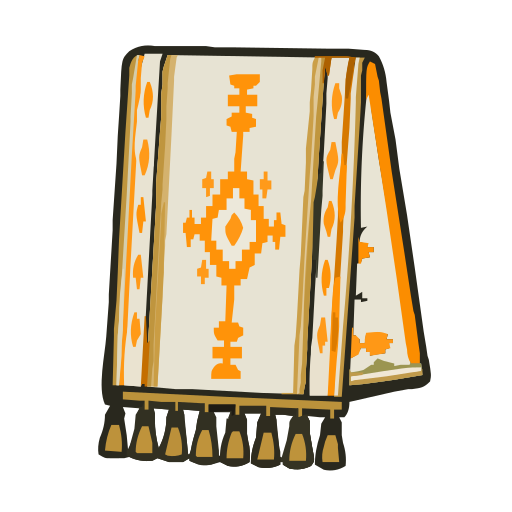
The hinggi is a large rectangular cotton mantle and it belongs to men. It is used in pairs: one cloth wound about the waist, the second thrown over the shoulders, and the pair together constitutes the dress. That format governs the design, because a cloth intended to be seen while draped is composed in horizontal registers that read correctly when the fabric hangs rather than lies flat. A hinggi displayed on a wall is being shown in a position it was never designed for, and its composition makes far more sense once that is understood.
Warp Ikat, and Why the Pattern Precedes the Cloth
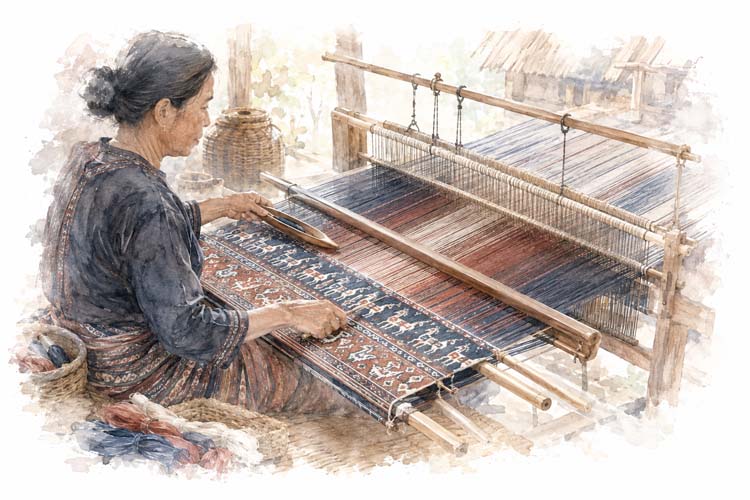
Sumba works in warp ikat. The warp threads are bound in bundles so that dye cannot reach the covered sections, dyed, unbound, rebound and dyed again for each additional colour, and only then stretched on the loom. Everything the finished cloth will show is decided during the binding, months before any weaving begins, and it is decided on thread that shows no image. The weaving itself is comparatively quick. The craft lives in the tying, as it does in every ikat tradition, and Sumba's figures are more pictorial than most, which makes the binding correspondingly harder.
The Red Nobody Could Simply Learn
The characteristic red is drawn from the bark and roots of morinda, and getting it deep and fast is a long process requiring repeated immersion and mordanting over an extended period. On Sumba that knowledge was not freely available: it was held by noblewomen as a guarded competence, transmitted within rank rather than taught to anyone who wanted it. A dye held as a class privilege is an unusual thing, and it explains why colour on this island reads as status rather than as decoration.
Black That Is Two Dyes
The deep near-black in Sumbanese cloth is not a black dye. It is produced by overdyeing red with indigo, which means a black passage has been through both dye sequences in full, with all the binding and unbinding each requires. That single technical fact tells a collector more about the labour in a hinggi than any description of the motifs: the darker the cloth, the more processes it has survived. It is also why old Sumbanese blacks have a depth that a directly dyed cloth does not achieve.
The Patron Institution
The patron here is rank, and it governed who could own what. Sumba's aristocracy commissioned, controlled and consumed the finest cloth, restricted certain motifs and colours by status, and used textiles in the enormous funerary ceremonies that remain the island's central ritual expenditure. Hinggi were used to wrap and accompany the dead, in quantities that reflected the standing of the household. That is a demanding patron in the most literal sense: cloth was consumed by burial rather than kept, which is why quantity mattered and why so much of what was made no longer exists.
Colour as a Sequence
Nothing is being preserved here. A sequence of operations simply cannot be shortened, and never could be. Bind, dye, unbind, rebind, dye again, and for black do the whole of it twice in two different dyestuffs. Each stage commits the cloth further and none of it can be revised. That irreversibility is the whole inheritance, and it is what a collector is actually paying for, whatever the motifs happen to be. In a Kaliuda compound someone is lifting a warp out of a morinda bath for the fourth time, and it is not yet the colour it needs to be.