The Living Legacy
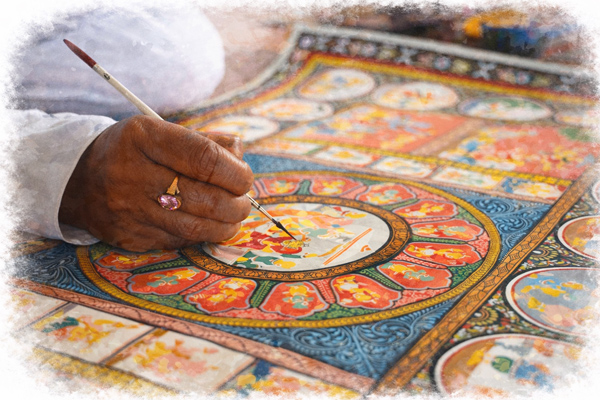
The Bhubaneswar–Puri–Cuttack region is not a cluster of historic cities but a continuously inhabited civilizational corridor where power, memory and devotion have flowed uninterrupted for over two millennia. To travel through this triangle is to witness how India's sacred imagination, royal ambition and artisanal intelligence evolved together. Read it as a collector reads provenance: every work that leaves this corridor, a painted patta, a stitched chandua, a thread of drawn silver, was made possible by the history below.
Kalinga: Where War Gave Birth to Conscience
The story begins in ancient Kalinga, a prosperous and fiercely independent region referenced in the Mahabharata and early Jain and Buddhist texts. In 262 BCE, near present-day Dhauli Hill, the Kalinga War altered the moral course of the Indian subcontinent. Emperor Ashoka's own rock edicts, still etched into stone, record his anguish at the suffering caused by conquest and his subsequent embrace of dharma. Local tradition adds poetic weight: elders still speak of the Daya River running red, a metaphor that transformed a conqueror into a moral philosopher. This land thus occupies a singular place in global history, not only as a battlefield, but as the birthplace of political remorse.
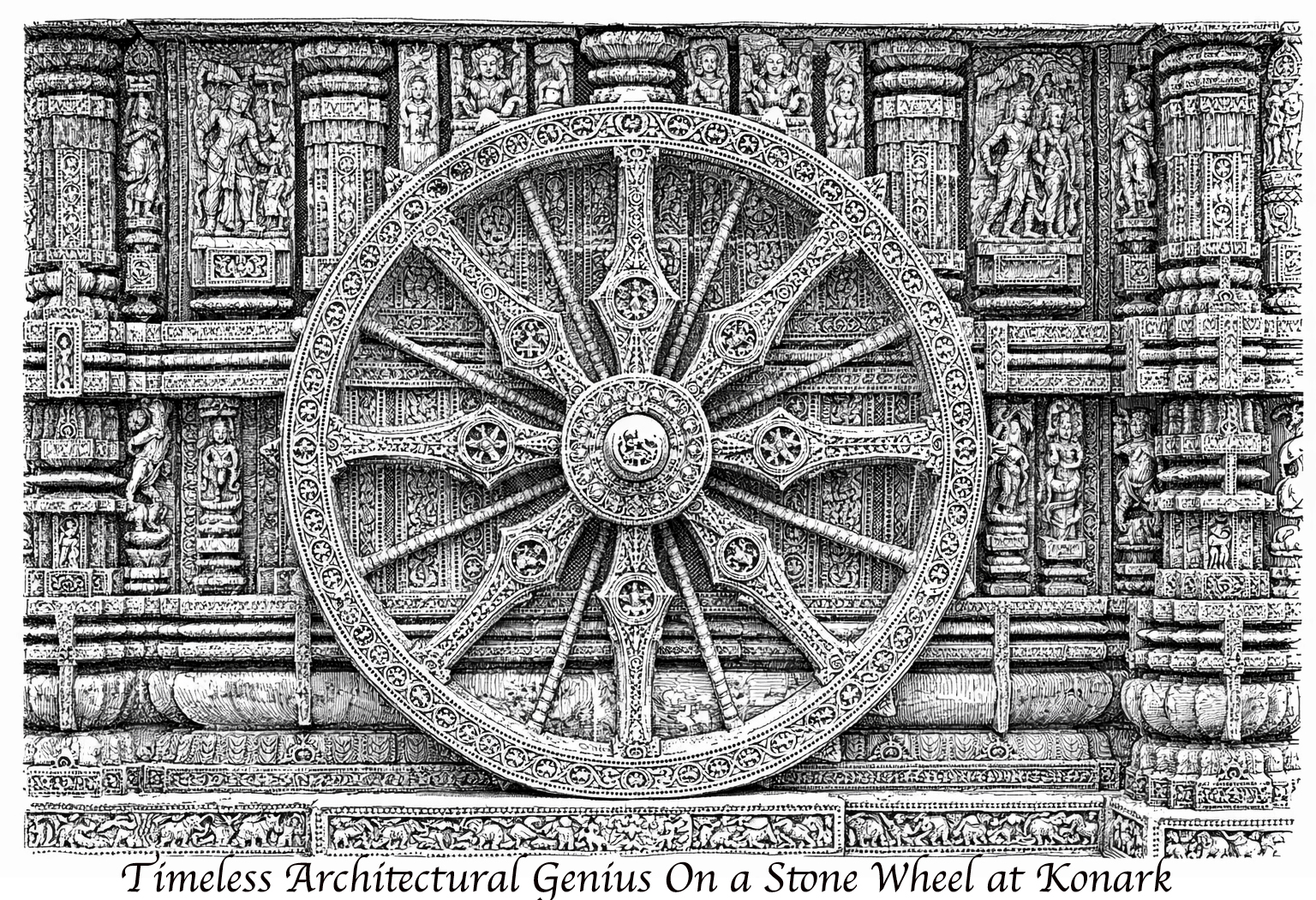
Soon after, the region asserted its indigenous strength under Kharavela in the first century BCE. His achievements, military, cultural and religious, are immortalized in the Hathigumpha Inscription, carved in ancient Brahmi script. These caves still whisper of a time when Odisha stood confidently at the crossroads of power and philosophy. The stone that took Ashoka's edicts and Kharavela's inscription still takes the carver's chisel; the corridor's sculptural line begins here.
Bhubaneswar: Ekamra Kshetra and the Rise of Temple Urbanism
Between the 7th and 12th centuries, Bhubaneswar emerged as Ekamra Kshetra, a sacred Shaivite landscape under the Somavamshi dynasty. What distinguishes Bhubaneswar is not a single monument, but temple density as urban design. Early shrines like Parsurameswar reveal experimentation; later masterpieces achieve perfection. The Lingaraja Temple, completed around 1025 CE under King Jajati Keshari, represents the zenith of Kalinga architecture, a vertical theology in stone refined over centuries.
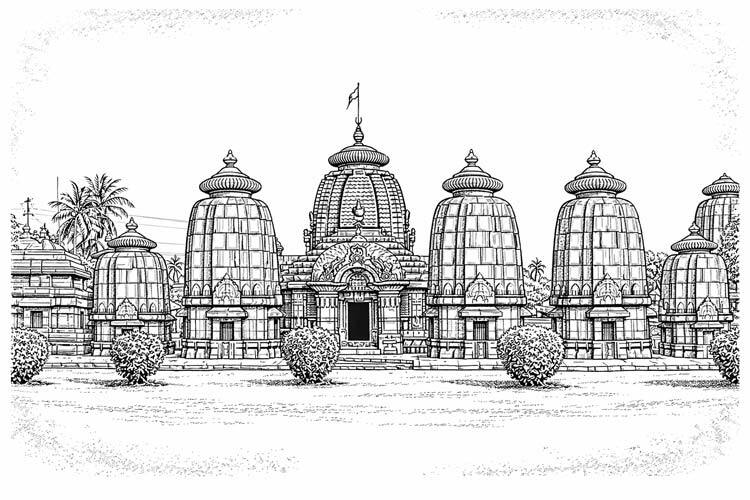
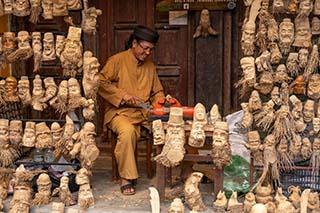
Here, temples were not isolated acts of devotion. They were anchors of civic life, surrounded by water tanks, dance halls and markets. Inscriptions record grants not just to priests, but to dancers, musicians and scholars, revealing a city where art, governance and worship were inseparable. The temple-builders never left: the sthapati families who carve sandstone deities and Konark-wheel replicas today descend from this workshop tradition.
Puri: Jagannath and the Radical Theology of Inclusion
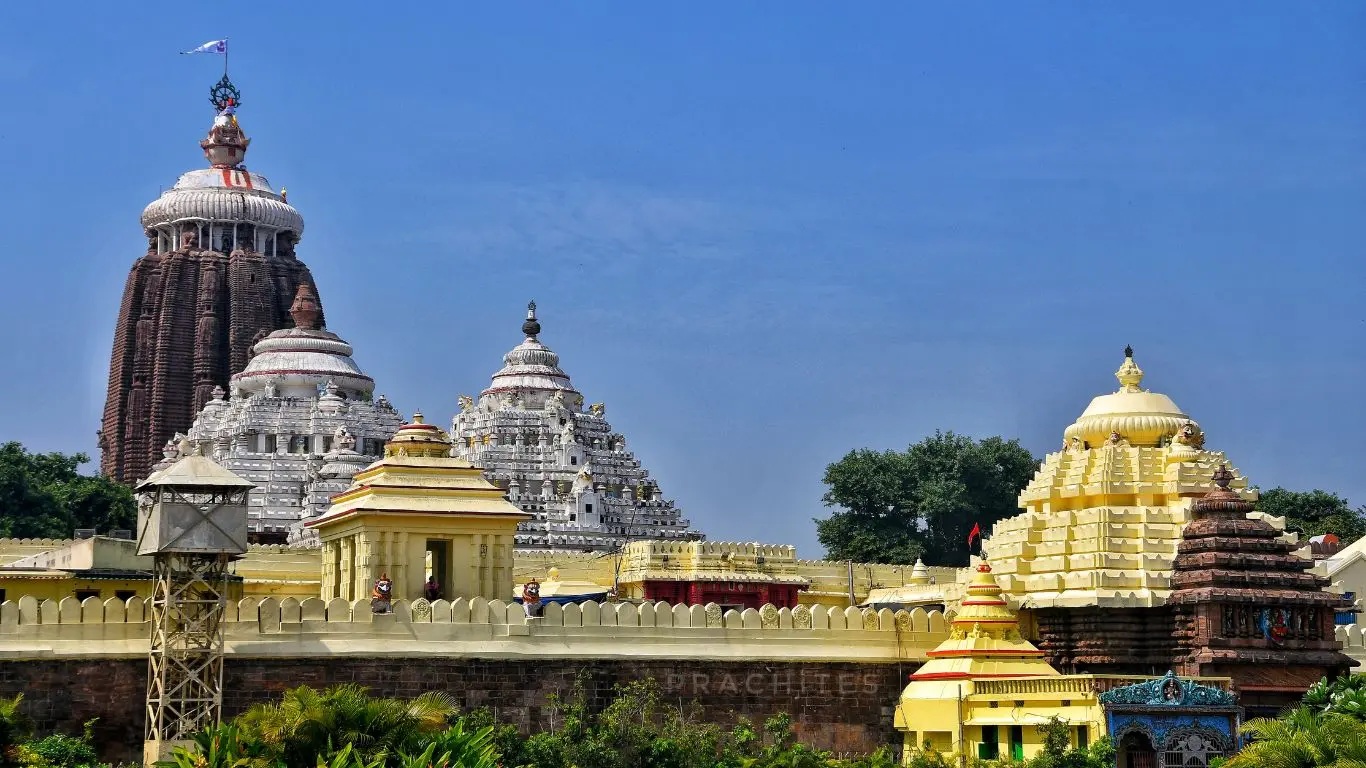
Sixty kilometers east, along the Bay of Bengal, another vision took shape. According to the Madala Panji, the temple chronicle, King Indradyumna dreamt of a formless deity on Nilachala Hill. That dream materialized in the 12th century when Anantavarman Chodaganga Deva of the Eastern Ganga dynasty commissioned the Jagannath Temple.
The wooden form of Lord Jagannath preserves tribal origins while embracing Vaishnavite cosmology, making Puri one of Hinduism's most inclusive sacred centers. The annual Rath Yatra, documented since the medieval period, draws millions as the deities leave the sanctum to meet the devotees. Nearly every craft in this corridor answers to this temple; its calendar is their oldest standing order.
Konark: The Sun Made Architectural
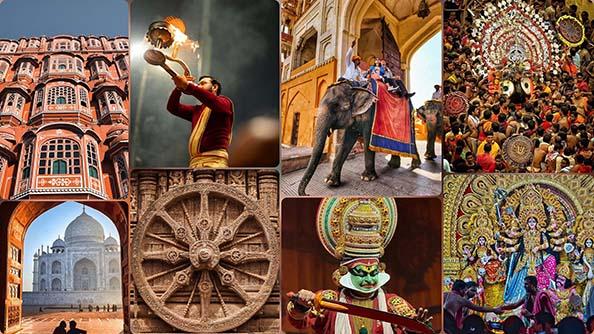
South of Puri, on the edge of land and sea, Konark rises not as a place of worship alone but as a cosmological statement. Commissioned in the 13th century by King Langula Narasimhadeva I of the Eastern Ganga dynasty, the Sun Temple was conceived as Surya's celestial chariot, drawn by seven horses and set upon twelve pairs of wheels that measure time itself. Here, architecture becomes astronomy, sculpture becomes mathematics, and devotion is rendered through precision rather than ornament alone. Though the temple stands partially in ruin, its intent remains intact: to bind cosmic order, royal power and human labor into a single monumental idea. Konark does not mourn what is lost; it asserts what was once imagined, that a kingdom could align itself so closely with the sun that stone itself learned to move with time. For the region's carvers, Konark remains the model: the high-water mark their workshops still measure themselves against.
Cuttack: Power, Trade, and the Silver Imagination
While Bhubaneswar sanctified and Puri sacralized, Cuttack governed. Founded in 989 CE, Cuttack became the political heart under Ganga and later Gajapati rulers. The Barabati Fort, born of legend and strategy, anchored royal authority at the confluence of rivers.
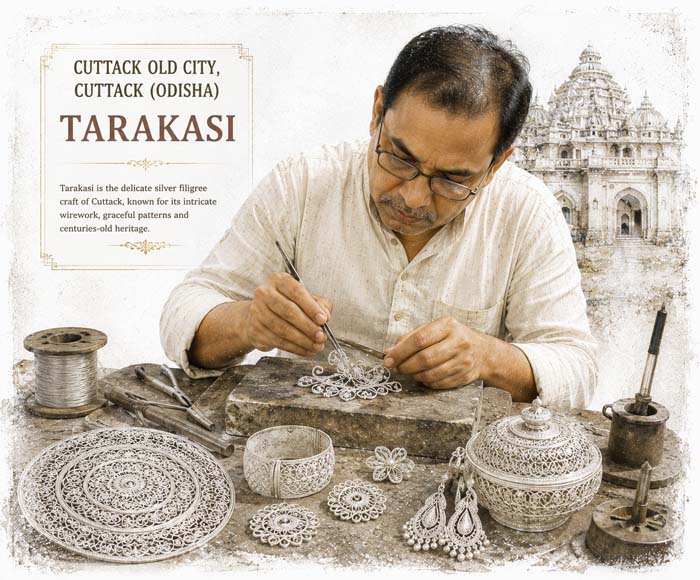
Under Mughal, Maratha and British administrations, Cuttack retained its administrative primacy. It also flourished as a trade hub, earning the name Silver City for its tarakasi filigree, a craft that still passes from hand to hand in narrow lanes.
Cuttack's festivals preserve memory as spectacle. Durga Puja, shaped by Chaitanya-era Vaishnavism, and Bali Jatra, commemorating Odisha's maritime trade with Southeast Asia, transform history into living celebration each year. Where Puri's crafts serve the temple, Cuttack's served the court and the trade routes; tarakasi is that worldlier patronage, drawn fine in silver.
From Kingdoms to Capital
Colonial rule shifted power but not identity. When floods and geography forced the British to plan a new capital, history turned full circle. Post-independence, modern Bhubaneswar rose as a planned city under architect Otto Königsberger, reclaiming political centrality without severing its sacred roots. Odissi dance revives temple sculpture in motion. Pattachitra painting preserves history on cloth. Rituals like Naba Kalebara renew divine form without altering meaning.
The Patron Institution
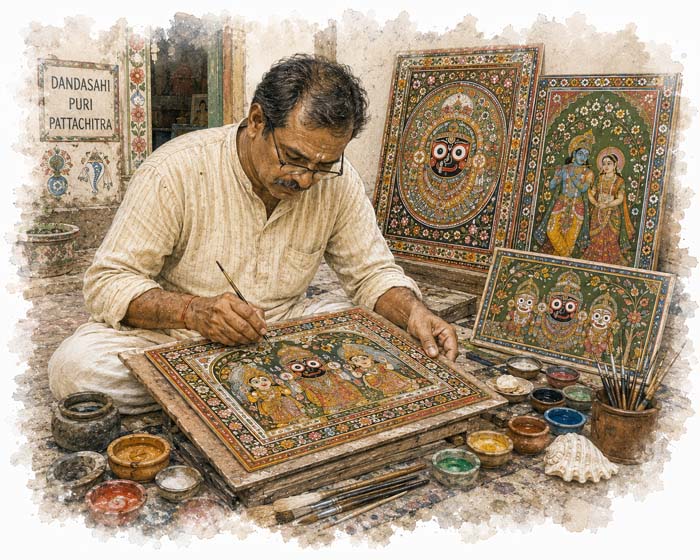
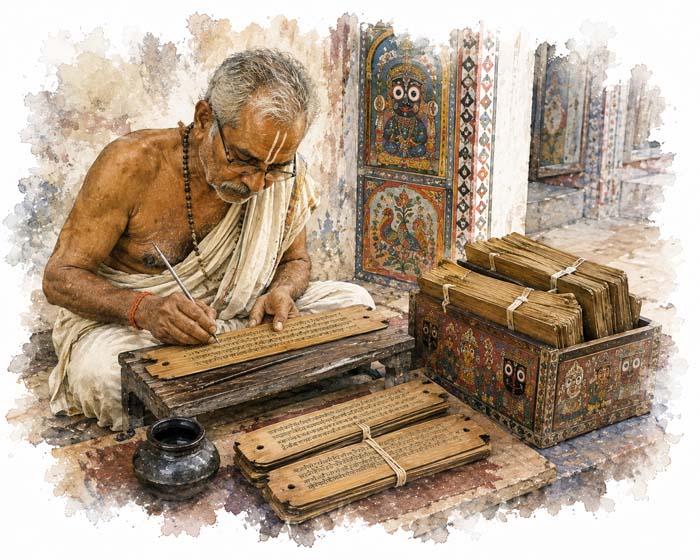
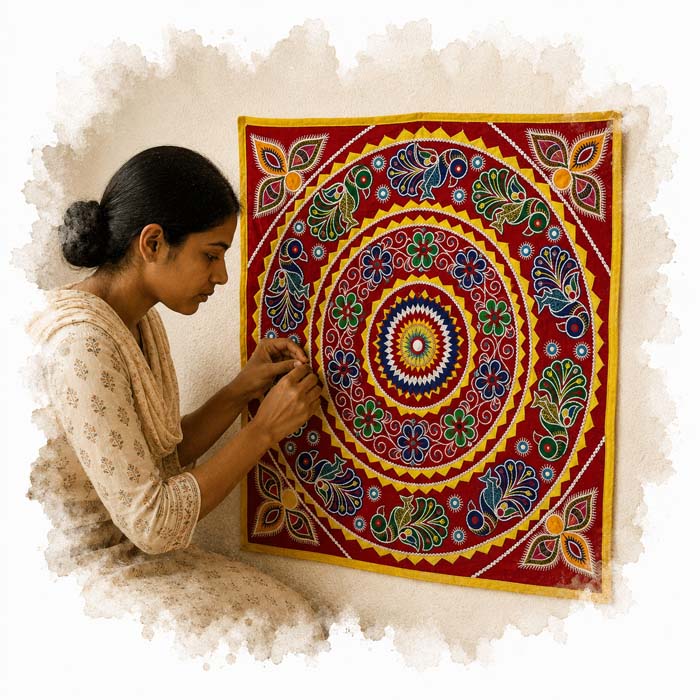
The line from that history to the works a collector encounters today runs through the temple. From the twelfth century, the Jagannath temple was not only a shrine but the coast's greatest patron, a landowner and employer whose ritual calendar demanded painting, appliqué, weaving and carving on a fixed annual rhythm. The Ganga and Gajapati kings, who styled themselves the deity's first servitors, settled hereditary artisan families in granted villages around Puri, each village bound to a duty passed from parent to child. That is why the crafts of this corridor live where they live: they were seated by decree and sustained by a calendar that has never stopped. Kingdoms rose and fell, but the temple's needs did not, and neither did the families who serve them.
A Living Civilizational Manuscript
The continuum is not frozen heritage; it is history in daily use. Empires fell, capitals moved and ideologies shifted, yet the region's cultural grammar endured. Here, a battlefield births peace, a dream builds a temple, a fort becomes a festival ground, and craft becomes memory. To journey through this landscape is not to look back; it is to recognize how India's sacred, royal and artisanal legacies still breathe in the present.