

Craft Map
The Craft Map
The craft here is a region rather than a workshop, and its objects are buildings. There is no Geographical Indication and there could not usefully be one, because what would be certified is a wall. What identifies work instead is the town, the house and the date the image itself gives away.
The Shekhawati Towns
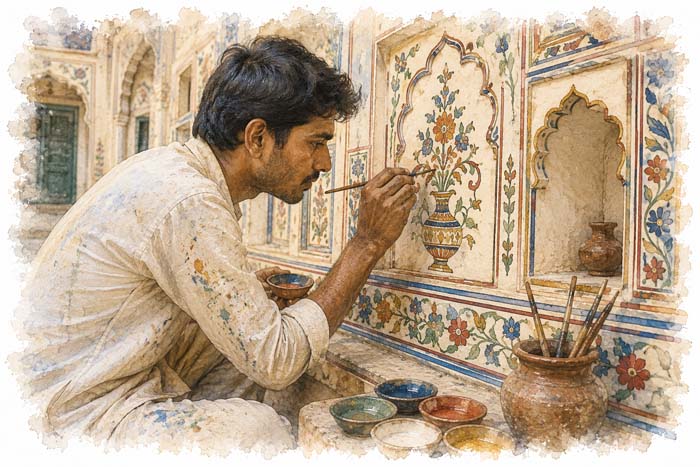
North of Jaipur, across a spread of towns including Nawalgarh, Mandawa, Fatehpur and Ramgarh, merchant families built and painted courtyard houses over roughly two centuries to the early twentieth. Around two thousand frescoed buildings survive across some thirteen thousand square kilometres. The method is true fresco, pigment into wet lime plaster, known locally as araish among other names, which is why the images have outlasted a century of neglect. A record should name the town and, where it can, the house.
Nawalgarh and Mandawa: The Dense Middle
The concentration is heaviest in the central towns, where streets carry painted facades more or less continuously and several houses are open or have been converted. This is where the competitive logic is most visible, because the buildings are close enough together that the families were plainly answering one another. For anyone trying to date the tradition by eye, these streets are the place to do it: a single lane can carry work spanning a century, and the technology in the images moves accordingly from palanquins to motor cars.
Bombay and Calcutta
Neither is in Rajasthan and both belong on this map, because they are where the money came from. The Marwari merchant families made their fortunes in the port cities and sent it home to build and repaint, so the frescoes are a remittance economy rendered in lime. They are also where the families eventually went for good, which is why so many of these houses stand locked and unmaintained today.
Also on the Map
The lime itself, which determines the palette and therefore the look of the whole region. And the printed images and photographs that reached these towns along the trade routes, which is how a painter in a desert town came to put a locomotive on a wall. Which town, and then which house: here the second answer is usually still standing.