One People, Four States
Sápmi is the Sámi homeland and it runs across the north of Norway, Sweden and Finland and into the Kola Peninsula in Russia, a single cultural region divided by four borders that were drawn without reference to it. The Sámi are the indigenous people of northern Europe, with their own languages, their own parliaments in three countries, and a reindeer-herding economy organised through cooperative units that manage herds and territory across distances most European countries could fit inside twice.
What the Materials Are
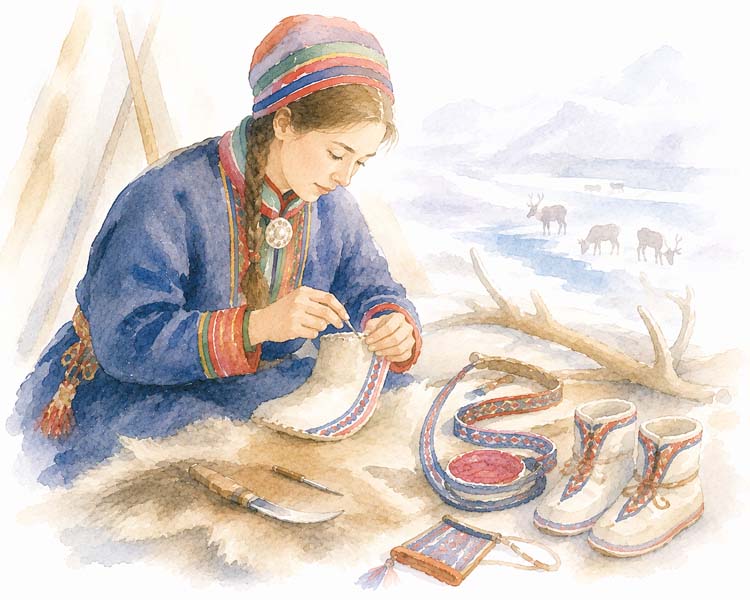
Everything comes from the herd and the forest. Reindeer supplies antler for handles, buttons and needle cases, bone, hide for boots and coats, and sinew for thread that swells when wet and seals its own stitch holes. Birch supplies burl, the dense knotted growth that will not split, for cups and bowls, and root for coiled baskets. Pewter is drawn into fine wire for embroidery on leather. None of it is bought in, and the craft is a direct read-out of what the land provides.
Hard and Soft
The division of the craft is by material and it maps onto gender. Hard duodji, worked in antler, bone and wood, has been men's work: knives, sheaths, cups, sledge fittings, carved and incised with patterns then rubbed with pigment so the lines read. Soft duodji, in hide, cloth and pewter, has been women's: boots, coats, bands, and the pewter-wire embroidery that is among the most distinctive techniques in northern Europe.
Why Sinew and Not Thread
The material choices are engineering decisions made in a climate that punishes error. Reindeer sinew, split and twisted, swells when wet so that a seam sewn with it closes its own needle holes and stops water entering, which cotton thread will not do. Hide is sewn fur-side out for shedding snow and fur-side in for warmth depending on the garment. Birch burl is chosen over straight-grained wood because interlocked grain will not split when a cup freezes with liquid in it. Every one of these is a survival requirement before it is a preference.
The Patron Institution
None external, and that is central. There was no court, no church commission and no market beyond the community for most of this craft's existence; duodji was made by a household for a household, judged by whether it survived use in a severe climate. What exists now is a set of Sámi institutions, including the duodji trademark established in the early 1980s and organisations that train and certify makers, which are self-governing rather than imposed.
What Was Done to Them
This belongs in the card. Norway, Sweden and Finland pursued assimilation policies from the nineteenth century into the twentieth: Sámi languages banned or discouraged in schools, children placed in boarding institutions, land rights eroded, and traditional practice suppressed. Earlier, missionaries confiscated and burned the drums used by Sámi religious specialists, and the joik, the Sámi vocal tradition, was condemned as sinful and driven underground. Recovery from this is recent, ongoing, and not complete; the last of those boarding institutions closed within the lifetime of people still working.
The Gákti Reads as Text
The traditional dress is not a costume. Its cut, colours, banding and fastenings indicate which area a wearer is from, and details can signal family and marital status, so a gathering is legible to anyone who knows the conventions. That precision is exactly why its casual reproduction as fancy dress by outsiders is resented: wearing one carries claims about who you are, and someone with no right to those claims is making false statements in a language they cannot read, to an audience that can.
Ornament That Is Not Decoration
The carved and incised patterns on antler, and the banding on clothing, belong to regional and family repertoires rather than to a general Sámi style, and a knowledgeable eye places a piece by them. They are also functional as often as not: an incised pattern rubbed with pigment gives grip on a handle that will be held in a mitten, and the banding on a garment marks and reinforces the seams it sits over. Very little of it is applied purely for effect.
Appropriation Is the Live Issue
The far north sells an enormous volume of Lapland-branded goods made by non-Sámi, frequently outside the region entirely, using Sámi motifs and imagery. That trade competes directly with Sámi makers and misrepresents the culture it borrows from. The duodji trademark exists precisely to separate the two, and looking for it is the single most useful thing anyone acquiring here can do.