Two Crafts a Ruler Decided On
Most craft places are explained by what was already there: a clay bed, a forest, a river, a temple that needed supplying. Mysore is explained by decisions. The painting tradition took its form because the Wodeyar court supported a manner of working and kept supporting it; the lacquered turnery at Channapatna exists because Tipu Sultan brought in artisans from Persia to teach a technique the district did not have. Neither craft grew out of the ground here. Both were chosen, and that shows in the work, which is more deliberate and less vernacular than crafts that arrived by accident of geology.
The Restraint That Costs More
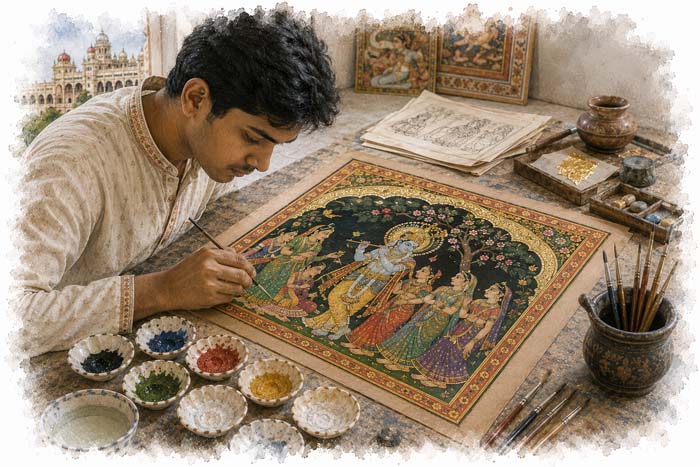
Mysore and Thanjavur painting are constantly confused, and the difference is technical rather than regional. Thanjavur builds thick gesso into high relief and lays substantial gold over it, often with set stones. Mysore uses a finer gesso in low, controlled ridges, raised just enough for gold leaf to catch the light, and the leaf itself is thinner. Thin leaf tears, creases and misplaces far more readily than thick foil, so the quieter surface is the more difficult one to execute. The restraint is not modesty of means. It is a harder specification, chosen.
Srirangapatna and the End of a Kingdom
The island fort at Srirangapatna, a short distance from Mysore, was the capital of Haidar Ali and Tipu Sultan and the place where their state ended in 1799. The Wodeyar house was restored to Mysore afterwards and ruled into the twentieth century, and the painting tradition belongs to that restored court as much as to anything earlier. This matters for dating: a Mysore painting sits inside a political history with sharp edges, and the question of which court and which decade is answerable in a way that it often is not for village crafts.
The Toy Town
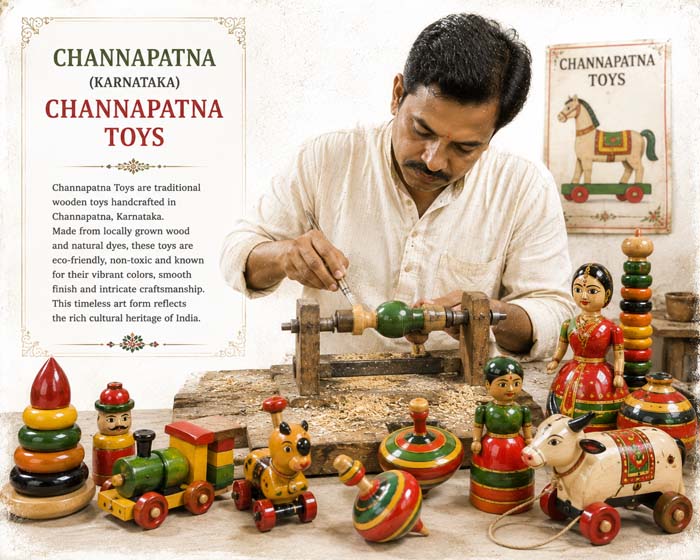
Channapatna, between Mysore and Bengaluru, is known locally as the town of toys. The craft is lac turnery: a piece is turned on a lathe and colour is applied as a stick of lac held against the spinning work, so the friction melts it onto the surface and the colour is burnished in rather than painted on. The wood is traditionally the ivory-wood of the region, soft enough to turn cleanly and pale enough to take colour. The lacquer and dyes are organic, which is why these objects have always been considered safe for children, and that is a property of the method rather than a modern reformulation.
The Court That Wrote the Manual
In the nineteenth century Krishnaraja Wodeyar III funded the compilation of a single work gathering the iconography and iconometry of the south's divine figures, and then had it illustrated by the miniaturists of his own palace. The Sritattvanidhi sets out forms of Shiva, Vishnu, Skanda, Ganesha, the goddesses, the nine planets and the guardians of the directions, with measurements and attributes specified, and one of its sections illustrates a hundred and twenty-two hatha yoga postures. Its effect was to standardise how deities were drawn and carved well beyond Mysore. A collector should register what that means: the studio that made the reference book is the same studio the painting tradition descends from.
The Patron Institution
The patron is the court, and courts behave differently from temples. A temple orders the same thing indefinitely; a court has taste, changes it, and can withdraw. That is the risk built into both crafts here and it is visible in their histories: the painting tradition contracted when the court's means did, and Channapatna's turners have spent the modern period finding buyers for a product no palace requires. The upside of court patronage is refinement, because a court will pay for difficulty. The downside is that when the patron goes, nothing structural replaces it.
Imported, Then Owned
What continues at Channapatna began as a transfer. Persian technique, brought in by a ruler, taught to local hands, and then worked for two centuries until it stopped being Persian in any meaningful sense and became the thing the district is known for. Craft histories are often told as unbroken descent from antiquity; this one is honestly a case of successful borrowing, and it is a better story for being told that way. The toys hold Geographical Indication protection granted in 2005.