Arts, Crafts and Living Ateliers
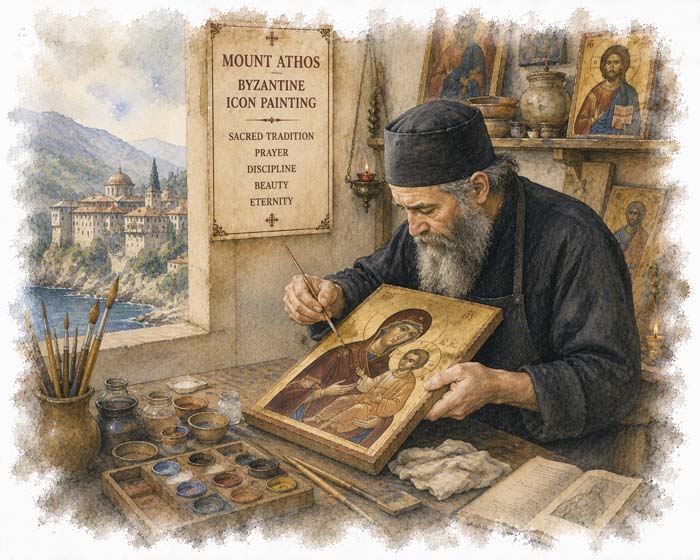
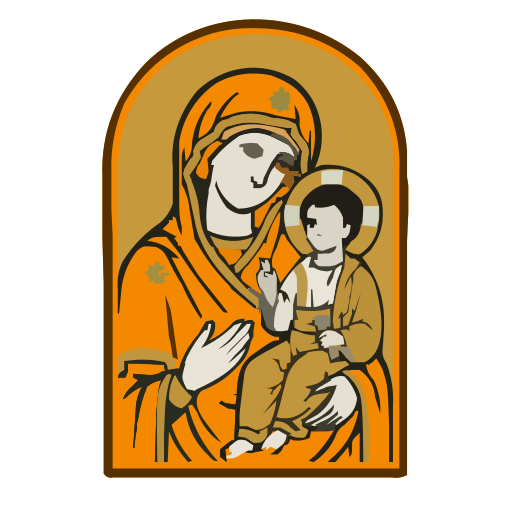
A painter works in a cell or a small workshop, on a wooden panel prepared with layers of gesso sanded smooth, sometimes over linen. Pigments are ground and bound with egg yolk thinned with water and a little vinegar or wine, mixed fresh because tempera does not keep. The drawing is incised or drawn onto the gesso, gold leaf is laid and burnished with an agate before any painting begins, and the layers follow in a fixed order that cannot be varied without the method failing.
Reading a Hand-Painted Icon
Under raking light, egg tempera shows fine brush hatching in the highlights, built as separate strokes rather than blended, and the surface has a slight tooth. A printed icon on board, which is sold in enormous quantity, is flat, perfectly even, and reveals a dot screen under a loupe; its gold is a metallic ink with no burnish. Real gold leaf shows tiny irregularities where sheets overlap and takes a mirror polish that print cannot imitate.
The Panel and Its Age
Turn it over. A traditionally made panel is solid wood with the back left bare, frequently with battens let across the grain to resist warping, and it will show the movement of timber over time. The painted surface sits in a shallow recess with a raised border, cut into the panel rather than applied. Modern commercial pieces use plywood or composite board with a printed image glued down, and the edges give this away immediately.
Byzantine, Cretan, Russian
Within the canon there are recognisable schools and confusing them is the common error. The Cretan school of the fifteenth and sixteenth centuries, working after the fall of Constantinople and much represented on Athos, is precise, linear and restrained. The Macedonian and later Athonite manners differ in modelling and palette. Russian icon painting is a separate development with its own regional schools. A record naming only Byzantine has said very little.
Beyond Icons
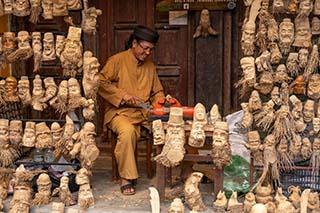
The monasteries sustain several other crafts that are less remarked on. Manuscript illumination and bookbinding continue, and the libraries here hold one of the world's great collections of Greek manuscripts. Wood carving produces the tall carved and gilded screens that separate sanctuary from nave, and small crosses cut in astonishing relief. Incense is compounded and sold. All of it answers the same liturgy and is made to be used in it.
Ateliers, Villages and Artisan Encounters
Athos itself is reachable by boat from Ouranoupoli with a permit, for men only, and the administrative centre is Karyes. For everyone else, the monasteries of Thessaloniki and Meteora, the Byzantine museums in Thessaloniki and Athens, and the Athonite dependencies outside the peninsula are where this tradition can be seen and where painters trained in it work. Icon workshops operate across Greece.
Why Antique Icons Are Refused
The market in old icons is one of the most compromised in art dealing. Churches and monasteries across the Orthodox world have been robbed persistently, particularly through the upheavals of the twentieth century and after 1991, and stolen pieces circulate with fabricated histories. Overpainting, transferred fragments and married panels are common, and confident attributions are frequently unsupportable. Commissioning new work from a living painter avoids all of it and supports the tradition rather than its dispersal.
Tourwit Editions and Provenance
Tourwit commissions new icons from painters trained in the Athonite tradition, working outside the peninsula, paying before work begins and leaving the major share of what a piece realizes with the painter. The record names them, states the panel, the pigments and binder, confirms genuine gold leaf rather than metallic ink, and identifies the school and prototype followed. Antique icons are not handled, because the trade in them is heavily compromised.
Why These Works Matter
Every other craft in this collection is improved by naming its maker. This one contests that on principle: the painter is deliberately effaced, the image belongs to a tradition rather than a person, and to sign prominently would be a theological error. It is the one heartland where the collection's own argument meets a coherent objection, and the honest thing is to record the hand while acknowledging that the painter would rather it were not the point.