The Object Is the Negative
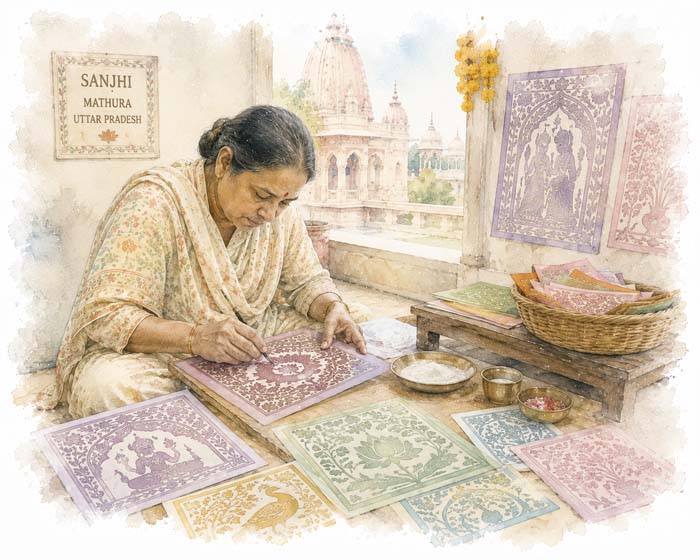
Almost every craft in this collection produces the thing that is kept. This one produces the thing that shapes what is kept, and then the kept thing is destroyed anyway. A sanjhi artist draws a design and cuts it out of paper with small curved scissors, turning the sheet rather than the blade, until what remains is a lattice holding itself together by the narrowest of bridges. That lattice is then laid down and filled with dry colour, and lifted away. What the worshipper sees is the powder. What the artist made is the absence.
Braj, and Why the Subject Never Changes
The Braj country around Mathura and Vrindavan is held to be where Krishna spent his childhood, and the entire devotional culture of the region is organised around episodes from that life. Sanjhi's imagery follows: the cows, the flute, the river, the round dance, the gopis. This is not a craft that developed a range of subjects and then chose among them. It illustrates one biography, in a place that believes the biography happened there, and its inventiveness goes into how a familiar scene is cut rather than into what is depicted. That constraint is shared with icon painting traditions elsewhere, but few of them work in a medium where a mistake destroys the sheet.
Dusk, and the Practice That Named It
The word sanjhi derives from sanjh, meaning dusk, and the association is with an evening observance. The practice flourished in the fifteenth and sixteenth centuries in the Vaishnava temples of the region, where it was carried out by priests rather than by a separate artisan caste, which is unusual and consequential. A craft performed by the people conducting the ritual is under different pressures from one supplied by a workshop; it does not have to sell, and it does not have to please anyone outside the temple.
The Image on Water
The most extraordinary application is the one done on water. A stencil is held over a still surface and the colour dropped through it, so that the design sits on the water rather than in it, held by surface tension. It cannot be moved, it cannot be kept, and any disturbance ends it. It is difficult to think of another Indian craft whose finest achievement is quite so deliberately temporary, and the fact that the technique exists at all tells a collector what the tradition values, which is the making rather than the made.
Cutting Without a Second Chance
The technical constraint that governs everything is that a cut cannot be undone. There is no erasing, no filling, no over-painting; a sheet is either finished or ruined, and a large design represents days of accumulated risk in which the last cut is as dangerous as the first. This is why the tradition prizes economy of line. Every unnecessary opening is another bridge weakened, and a composition that looks generous with detail is in fact the result of deciding, repeatedly, what could be left uncut.
The Patron Institution
The patron is the temple, and specifically a temple culture in which the deity is treated as a resident to be entertained through the day and the year. That produces demand for things that are consumed: flowers, dress, food, and images made for an evening. Sanjhi belongs to that economy of the perishable. It was never a trade good and it acquired a market only recently, which is why so much of what is now sold is the paper cut itself, mounted and framed, rather than the powder image the paper cut was invented to produce.
What Is Being Sold Now
The tradition has therefore inverted. What survives commercially is the stencil, presented as a work in its own right, sometimes cut so finely that it is exhibited on a dark ground or between glass. That is an honest development and it has kept the skill alive, but a buyer should understand the shift: they are acquiring the tool, elevated. The craft holds Geographical Indication protection under Mathura's name, which ties it to the region where the practice belongs. The registration protects the name; it does not distinguish a cut made for a temple floor from one made for a wall, and only the maker can do that.