Arts, Crafts and Living Ateliers
The contemporary workshops are small and concentrated in a few towns on the island and on the mainland nearby. Vessels are built by hand rather than thrown, using coiling and modelling, then dried, incised while leather-hard, slipped in red and white, burnished and fired. The incising is the defining labour: fine parallel lines and excised fields cut into a surface that is neither wet nor dry, in a window of a few hours when the clay will take a clean line without tearing.
Reading the Decoration
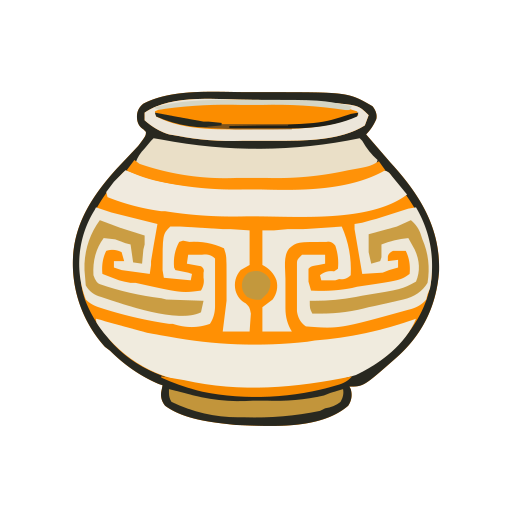
Marajoara ornament is built from a limited geometric grammar: bands of parallel incision, hatched and cross-hatched fields, scrolls, and stylised eyes and limbs resolving into figures if you look for them. Good contemporary work uses that grammar coherently, with the fields balanced and the incision even in depth; weak work scatters motifs without structure. Compare anything offered against museum photographs before deciding, because the ancient material is exceptionally well documented and the comparison is easy to make.
Reproduction, Interpretation, or Antiquity
Three categories share this vocabulary and a buyer should be able to place a piece in one of them. A close reproduction copies an excavated vessel and should say so. An interpretation uses the idiom on a new form and is the bulk of honest contemporary production. An antiquity is excavated material and belongs in a museum in Brazil rather than in a private collection. Sellers who blur the first and the third are the reason this card is written in these terms.
The Clay and the Firing
The island's clays are river clays and the traditional bodies included tempering with cauixi, a freshwater sponge, and with crushed sherds, which is visible in ancient material as a characteristic gritty texture. Contemporary work varies in whether it follows that. Firing is at relatively low temperature and the surfaces are slipped and burnished rather than glazed, so a piece with a glassy glaze is not working in this tradition whatever its decoration looks like.
Why Leather-Hard Matters
The incising that defines this ware can only be done in a narrow condition. Wet clay tears and smears under a tool; dry clay chips and crumbles. Between the two there is a leather-hard state, lasting hours rather than days, in which a line cuts cleanly and holds its edge, and every incised field on a Marajoara vessel was made in that window. A large piece therefore has to be planned so that the whole decorative programme can be executed before the clay moves on, which is a scheduling problem as much as an artistic one.
Where the Modern Work Departs
Contemporary Marajoara ware is generally lighter, smaller and cleaner than the ancient material, for the ordinary reason that it is made to be sold, carried and displayed rather than buried. Forms are adapted to modern use, walls are thinner, and the incising is often finer than on the funerary vessels. None of that is a fault, and a buyer expecting a workshop piece to look like a museum urn is expecting the wrong object. What should match is the coherence of the decorative grammar, not the weight of the pot.
Ateliers, Villages and Artisan Encounters
Marajó is reached from Belém by boat across the bay, and the island is large, wet and slow to travel. The ceramic workshops are findable and the artisans are generally straightforward about what they are making and from what source. Belém itself holds the collection that is the reference for all of it, and seeing that first is the only sensible order in which to approach this craft.
Tourwit Editions and Provenance
Tourwit works directly with ceramic workshops on Marajó and in Pará rather than through intermediaries. Artisans are paid before the work begins and retain the major share of what a piece realizes. Editions are limited by what a hand can build and incise, and each work is documented at source with its maker, its town, and an explicit statement of whether it is a reproduction of a documented vessel or a contemporary design in the idiom. No excavated material is offered.
Why These Works Matter
Every other card in this collection describes a craft with people still holding it. This one describes a vocabulary held by objects rather than by hands, recovered by artisans who live where it was made and have taken it up deliberately. That is a weaker claim than continuity and a more interesting one, because it makes visible what the other cards can take for granted: that a tradition is a chain of people, and when the chain breaks what remains is evidence, and someone has to choose to pick it up. On this island someone did.