


Craft Map
The Craft Map
Two crafts in one city, distinguished by material and by intention rather than by place. One holds a mark that ties it to Lucknow; the other holds a mark whose purpose is to distinguish Lucknow's version from the same craft made in half a dozen other Indian cities.
Lucknow: Chikankari
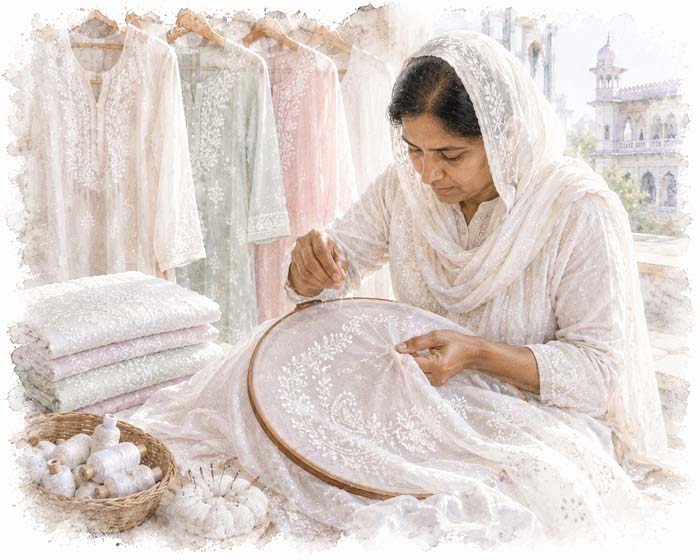
The white work belongs to the city and the districts around it, and it is made in households rather than in workshops, which is why it has no single address and why the embroiderer is a real question with a real answer. More than thirty stitches are in the repertoire, among them bakhiya shadow work laid on the reverse, needle-opened jali, and the raised murri and phanda knots. Lucknow chikan craft holds Geographical Indication protection granted in 2008.
Lucknow: Zardozi
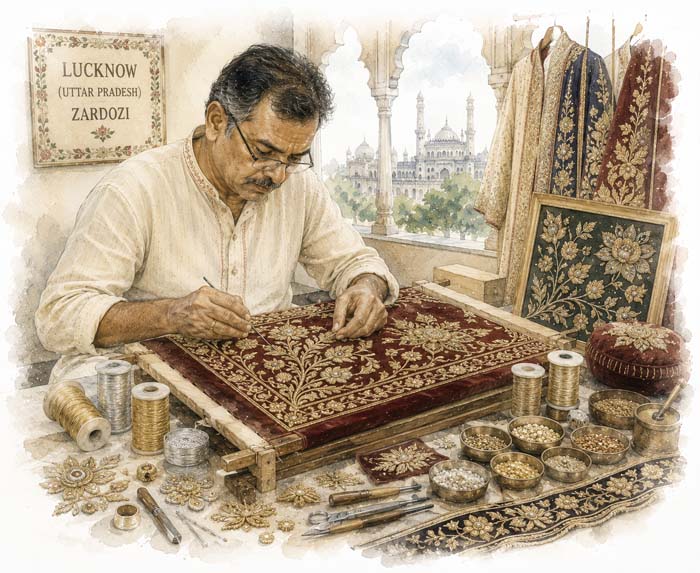
The metal work is done on a stretched frame in workshops in the old quarters, with several hands to a frame. Gold and silver thread historically, with sequins, beads, pearls and stones, over padding that gives raised motifs their form. Because zardozi is worked in many Indian cities, the Lucknow registration functions as a boundary rather than as a claim of uniqueness, and asking for it is asking where a piece was made rather than what it is.
The Districts Around the City
A great deal of the white work is stitched well outside the municipal boundary the name implies, in villages across the surrounding districts where women embroider at home between other work and are paid by the piece through a chain of middlemen. The city is where it is finished, washed and sold. A record naming Lucknow and nothing else has named the last address rather than the hand.
Also on the Map
The block printers and the washermen, who bracket the chikan process at both ends and are as necessary to it as the embroidery. The imambaras, which are the city's own architecture and the reason metal-thread work here has a use beyond dress. And the fine mulmul and other open cottons the white work is stitched on, whose looseness of weave is what lets the needle-opened jali and the shadow stitch read at all. Which craft, and then whose hand: in Lucknow the second question is answerable, and it is almost never asked.