The T'boli
The T'boli are an indigenous people of the South Cotabato highlands in Mindanao, living around Lake Sebu and its surrounding lakes and forest, and they are one of the Philippine groups who were never substantially Christianised or Islamised and retained their own religious world. Their material culture is dense: brass casting, beadwork, embroidery, and above all the cloth. They are also, like most indigenous communities in Mindanao, under sustained pressure from land encroachment and from the loss of ancestral domain.
Abaca, Not Banana
The fibre comes from a plant closely related to the banana but grown for its stem rather than its fruit. Stalks are cut, the sheaths stripped, and the fibre scraped from them by hand with a blade drawn against a board, then dried, and then the individual filaments are knotted end to end into a continuous thread. That knotting is done by hand, filament by filament, and it is the most time-consuming part of the whole process before any dyeing begins, and it is done sitting down over weeks.
Three Colours and No More
The palette is fixed: the natural pale straw of the fibre, a red-brown from a root, and black. Nothing else. Every design in the tradition is built from those three, and the restriction is absolute rather than conventional. It means the entire expressive range of the cloth lies in pattern, proportion and the relationship of light to dark, which is a severe discipline and one reason the results look as graphic and as modern as they do to outside eyes.
Dreamed Designs
Patterns are understood to be given rather than composed. A weaver receives a design from Fu Dalu, the spirit of abaca, in a dream, and the authority of a design rests on that. It is not a figure of speech and it has practical consequences: a weaver does not sketch, does not copy another's dreamed pattern without cause, and holds the whole composition in memory while tying hundreds of resist bindings. The named master weavers of the community are known as dream weavers.
Tying the Design Into the Fibre
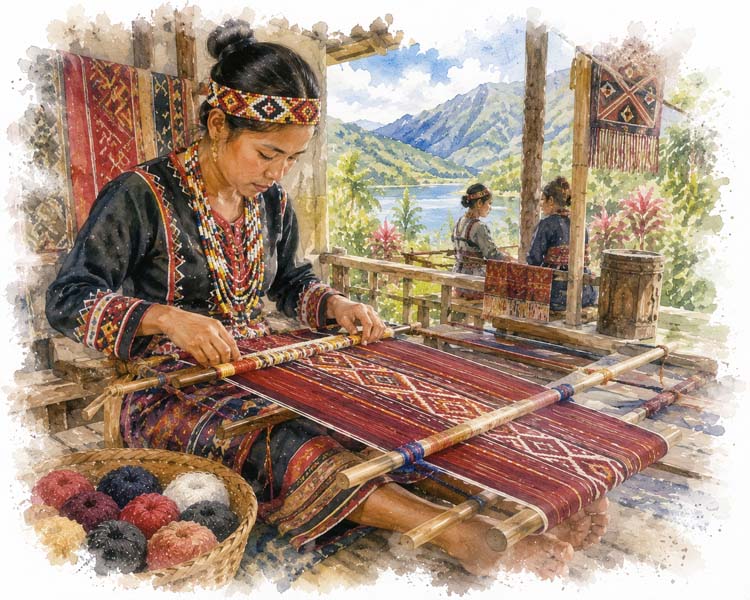
The technique is warp ikat, and it is the harder direction. Threads are laid out in order on a frame and bound tightly wherever dye must be kept out, dyed, rebound and dyed again, and then transferred to the loom with their sequence intact. Because the pattern runs along the warp, any error in counting or alignment is locked in for the entire length of the cloth rather than for a single pass, and there is no adjusting it later.
The Patron Institution
None external. This was cloth for the community's own use, in bridewealth, in ceremony, as a covering and as a marker of status, and it was not made for sale until recently. There is no court, no temple, no guild. What has appeared in the last few decades is a market, and with it the usual pressures: demand for faster production, for larger pieces, and for designs made to order rather than received in sleep, which is a direct challenge to how the tradition understands itself.
What the Cloth Is Used For
T'nalak functioned as a form of wealth. It was exchanged in bridewealth negotiations, used to wrap the dead, given at significant occasions, and treated with respect that extends to rules about handling: it was traditionally not to be stepped over, and cutting a piece required an offering. Selling it to outsiders was, within living memory, not something that was done at all.
Where the Colours Come From
The two dyes are local and neither is quick. The red-brown is drawn from the roots of a plant, prepared and applied over repeated immersions to build depth, and the black comes from a leaf and mud process that darkens the fibre through several cycles. Both require the bindings to be reset between stages and both take days rather than hours. The pale ground is simply the abaca left undyed.
The Weaver Everyone Knows
One woman, Lang Dulay, became the internationally recognised figure of the tradition, held over a hundred dreamed designs, was designated a National Living Treasure by the Philippines, and taught a generation before her death in 2015. Her prominence is genuinely deserved and it also illustrates the pattern this collection keeps meeting: one name enters the record and the other weavers around her, working to the same standard, do not.