Arts, Crafts and Living Ateliers
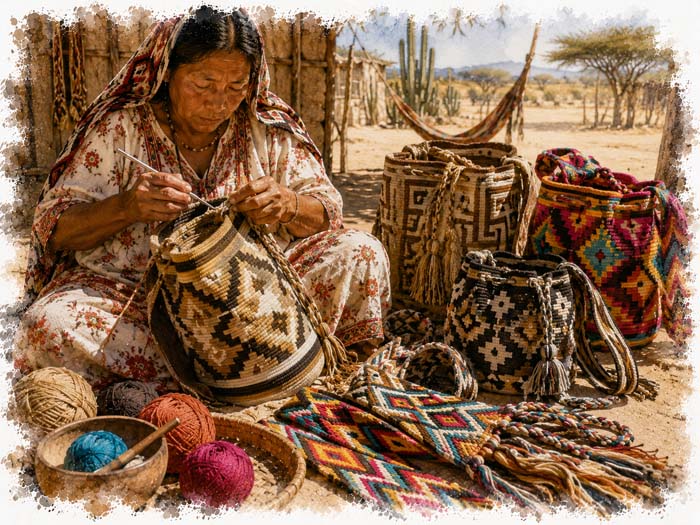
The work is done seated, at home or in the shade outside it, with the yarn managed by hand and, in the double-thread technique, by foot. It is portable and it is fitted around everything else a household in a dry country has to do, principally the fetching of water. A bag grows in a spiral from the base, so the pattern has to be planned as a continuous helix rather than as rows, which is a considerable feat of mental arithmetic sustained over weeks, carried in the head rather than on paper.
Reading a Mochila
Feel the fabric first. Single-thread work is finer, more flexible and lighter for its size, with smaller, denser stitches and crisper pattern edges; double-thread is thicker, stiffer and coarser-stitched. Look inside at the colour changes: hand crochet carries the unused colour along inside the stitch, which shows as a slight ridge, while machine work does not. Check the base spiral for regularity and the strap, since a hand-woven strap is a separate piece of work and a cheap machine strap on a hand-crocheted bag is a common shortcut.
The Strap Is Its Own Craft
The band that carries the bag is woven rather than crocheted, on a small loom, and it is frequently the finest piece of work on the object. On a good mochila the strap is dense, tightly patterned and made by the same household. It is worth looking at separately, partly because it is beautiful and partly because it is the element most often substituted when a bag is being assembled cheaply from parts made in different places. Compare the density of the strap with the density of the body: on a coherent piece they match.
Asking the Right Questions
Three questions settle almost everything: single thread or double, who made it, and what the figures are called. A seller who can answer all three is connected to the weaver. A seller who can answer none is selling from a wholesaler and may not know. Neither situation is a scandal, but the price should reflect which one you are in, and a bag sold as a month of one woman's work should be priced as a month of one woman's work.
Colour, and Where It Comes From
The yarn is bought, industrially spun and industrially dyed, and that is worth stating plainly because the palette is often described as though it were traditional dyeing. It is not. The colours are commercial acrylic and cotton, chosen by the weaver from what is available, and the brilliance that makes these bags recognisable is a modern material used with a traditional vocabulary. That combination is entirely legitimate. It also means yarn is a cash cost paid before any income arrives, which matters when discussing price.
Ateliers, Villages and Artisan Encounters
The Wayuu rancherías are spread across a dry and difficult peninsula, and visiting is a matter of arrangement and of respect for a community that receives a great deal of attention and rather little benefit from it. Riohacha and Uribia are the practical points of contact on the Colombian side. Cooperatives working directly with weavers are the sensible route for anyone who wants both a good bag and a clear conscience about it.
Tourwit Editions and Provenance
Tourwit works directly with Wayuu weavers in La Guajira rather than through intermediaries, which in this craft is the entire ethical question rather than a detail of sourcing. Artisans are paid before the work begins and retain the major share of what a piece realizes. Editions are limited by what one woman can crochet in a month, and each work is documented at source with its weaver, her ranchería, whether it is single or double thread, and the names of its figures, so that the record travels with the object.
Why These Works Matter
A single-thread mochila is a month of a named woman's working life, made in one of the driest and poorest regions of South America, carrying a named repertoire of figures that most buyers have never heard of. It is also one of the most copied craft objects in the world. Holding a genuine one and being able to say who made it and how is the difference between supporting a craft and consuming a pattern.