


Craft Map
The Craft Map
Four crafts across western Bengal, each in its own place and each answering to a different kind of buyer. Two carry Geographical Indication protection and two do not, and the difference is worth naming.
Bolpur and Santiniketan: Kantha
North-west of Kolkata, around Bolpur, kantha is stitched in households rather than workshops, which is why it has no single address. Santiniketan alongside it is Tagore's school of 1901 and the university of 1921, inscribed by UNESCO in 2023, and the association has shaped how the stitch is taught and sold in the modern period. For an old piece the questions are whose household and what cloth; for a new one, whose hand.
Bishnupur: Baluchari
West of Kolkata, Bishnupur is a temple town of terracotta and the present home of a weave that began at Baluchar on the Bhagirathi in Murshidabad in the eighteenth century. The narrative pallu, built in supplementary weft, is the identifying element. Baluchari and Bishnupur silk hold Geographical Indication protection granted in 2011.
Charida, Purulia: The Chhau Mask
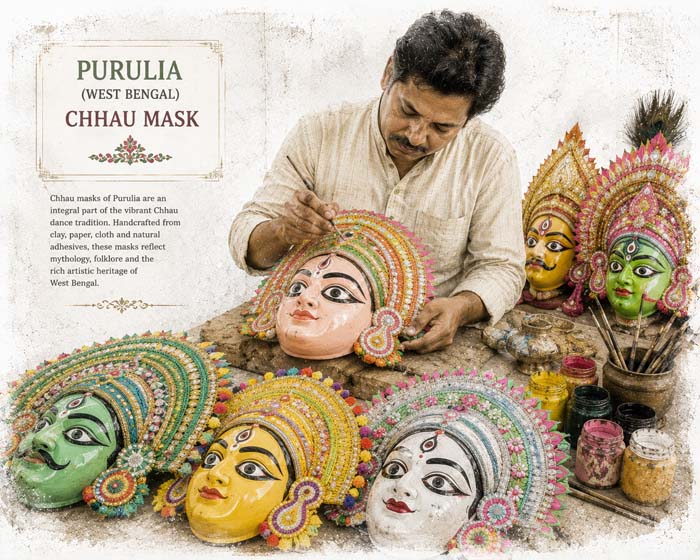
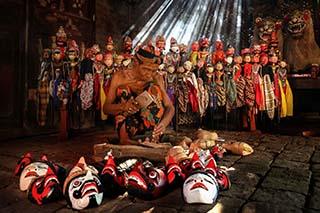
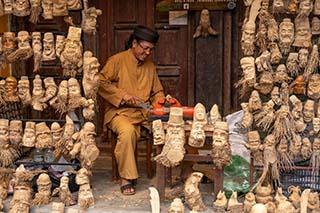
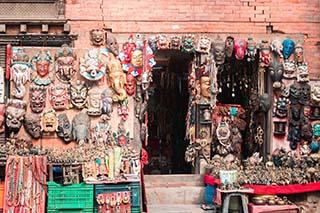
In the far west, in the foothills of the Ajodhya range, Charida is a village of mask-makers, more than a hundred and fifty families of the Sutradhar community working along one road. The masks are built up from clay, paper, cloth and natural colour over several days, and they are made for the spring dance rather than for a wall. Purulia Chhau masks took Geographical Indication protection in 2018.
Kalighat, Kolkata: The Painting
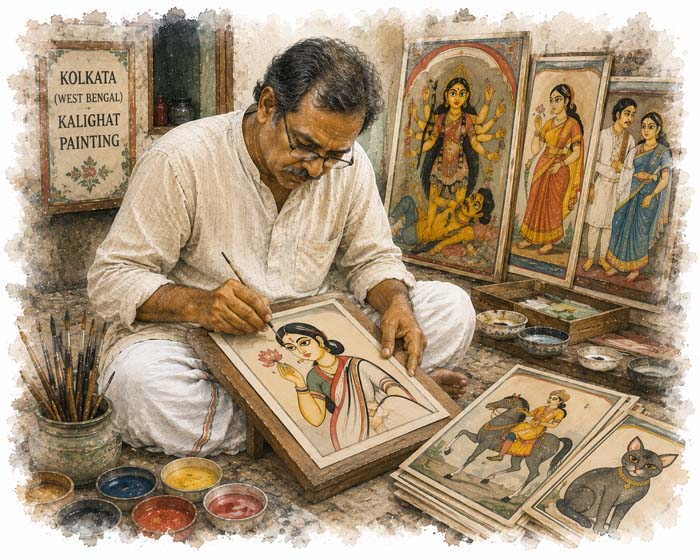
In the city itself, around the Kali temple, painters produced quick bright pictures for the crowds through the nineteenth century. No mark attaches to the tradition and the historic market for it is gone; what identifies the work instead is the manner and the collections that preserved it, the largest of which is in London. A modern piece in this style is a continuation rather than a survival, and should be described as one.
Also on the Map
Murshidabad, where the Baluchari weave started before it moved. The Kumortuli quarter of Kolkata, where the clay images for the autumn festival are modelled every year and destroyed every year. And the worn saris themselves, which are the raw material of one of these four crafts and the reason it costs nothing to begin. Which craft, and then whose household: in Bengal the second question is usually the harder one.