A School Named After a Place Nobody Can Find
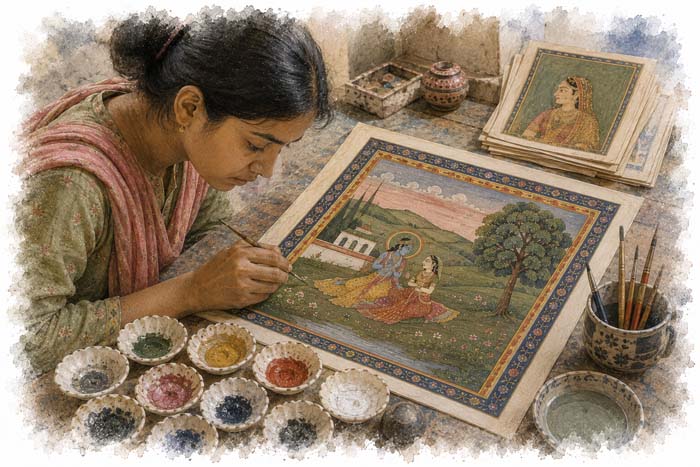
Malwa painting is seventeenth-century work centred on Malwa and Bundelkhand, which is why it is also called Central Indian. Its manner is unmistakable: rigorously flat compositions, grounds of black and chocolate brown, figures set against solid patches of colour, and architecture picked out in bright hues that refuse perspective entirely. The awkward part is the geography. A Ragamala of 1680 records that it was made at Narsyang Shahar; an Amaru Sataka of 1652 names Nusratgarh. Neither place has been identified to general agreement. The school is named for a region because its actual addresses are lost. That is an honest position for scholarship to hold, and it is a useful warning about how much certainty a school name can carry.
Orchha's Own Claim
This matters for the destination. The territory the Malwa manner covers includes Bundelkhand, and the Rajput courts of Orchha, Datia and Panna belong to that country. A painting filed under Malwa may have been produced at a Bundelkhand court, and Orchha is one of them. So the pairing of these two towns with this school is more defensible than it first appears, provided nobody claims more precision than the evidence supports. What can be said is regional. What cannot be said is which palace.
1981, Patangarh
The other tradition has a start date. In 1981 the painter Jagdish Swaminathan found a young Pardhan Gond man decorating the mud walls of his house at Patangarh, in what is now Dindori district, and took him to Bhopal to paint at the Bharat Bhavan. Jangarh Singh Shyam moved from walls to paper and canvas and developed a manner so distinct that it carries his name, the Jangarh Kalam. He is the first modern Gond artist in the plain sense that there was no such thing before him.
A School With a Founder
Almost no Indian craft can name the person it descends from. This one can, and the consequences run right through it. The artists working in the manner today are largely from the same community and frequently from the same extended family, and the visual vocabulary, the fine dots and dashes filling every form, the animals and trees of Gond narrative, was assembled by one man within living memory. That is an unusually short and unusually well-documented chain, and it makes attribution a real question rather than a regional guess.
What Jangarh Kalam Actually Changed
The move from wall to canvas was not a simple transfer. A mud wall is large, textured, communal and impermanent; it is replastered and repainted, and no one signs it. Canvas is small, smooth, portable, durable and owned. Working out how a village visual language behaves under those conditions was the actual invention, and it involved decisions about scale, about the density of the fill, and about how a composition holds together when it can be looked at from a foot away rather than across a courtyard. Those decisions are why the manner has a name.
The Patron Institution
The two traditions had different ones and neither is a temple. Malwa painting answered to Rajput courts holding fiefs granted under Mughal authority, which is why the manuscripts are literary and courtly: Ragamala sets, poetry cycles, the Ramayana. Gond painting answered to an institution that did not exist until the twentieth century, a state arts centre with a director who went looking. In one case the patron has vanished so completely that its addresses are gone; in the other the patron is a building in Bhopal that can be visited.
Wall First, in Both Cases
What connects them is where they started. Gond painting was on the mud walls of houses before it was anything else, made by women and men decorating their own homes with figures and protective marks. Malwa's ancestors were manuscript pages, but the tradition it belongs to had its own wall and palace painting behind it. Both moved to a portable support because somebody outside the tradition wanted to own the result, and in the Gond case we know exactly who, and when, and can read what he said about it. Very little of Indian craft history is documented at that resolution, and the contrast between the two halves of this card is the reason it is worth pointing out.