The Great Plain
Kalocsa sits on the Danube in the southern part of the Hungarian plain, flat country of grain, orchards and paprika, and an archbishopric since the eleventh century. The surrounding villages, particularly the Sárköz district, developed a distinctive material culture in a region that is agriculturally rich and was, for most of its history, socially conservative and comparatively prosperous, which is the condition that lets a village afford competitive display.
White, Then Blue, Then Everything
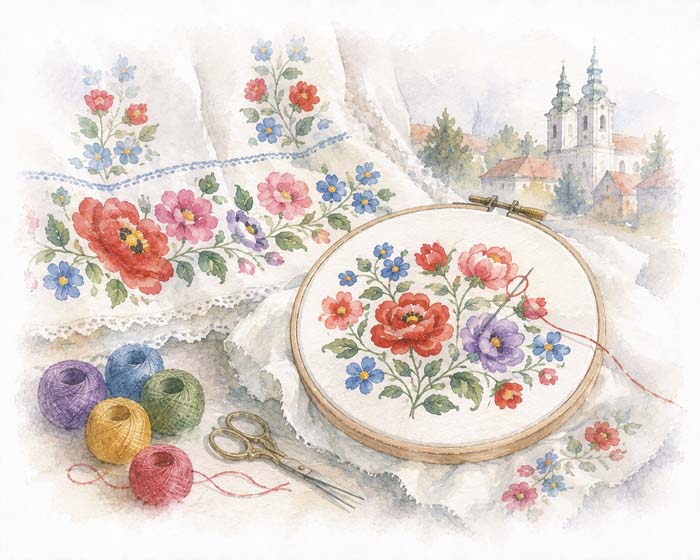
The chronology is documented and it is the most useful fact about the craft. Kalocsa work begins as whitework, white thread on white linen, closer to a lace effect than to painting. Colour enters in the later nineteenth century, first sparingly in blue and red, and then expands rapidly until by the early twentieth century pieces carry a dozen or more colours in dense floral fields. A piece can be placed within a couple of decades by its palette alone.
Why It Changed So Fast
Cheap aniline dyes and mill-spun cotton thread arrived in the countryside in the later nineteenth century, and the constraint that had kept the work white simply lifted. What followed was not a slow evolution but a competitive expansion: villages and individual embroiderers pushed the density and the colour count, and fashion moved every few years. This is folk art behaving like fashion, which it frequently does and is rarely described as doing.
The Writing Women
The designs were drawn freehand onto the cloth by specialists, and they had a name and a standing: the íróasszonyok, the writing women, who did not embroider but composed. An embroiderer bought or commissioned a drawn cloth from one of them and worked it. The best were locally famous, their styles recognised and their work sought, and their names are recorded in the local literature. In a supposedly anonymous folk tradition there is a documented class of named designers.
The Same Hands Painted the Walls
Those women also decorated interiors. Kalocsa wall painting, applied directly to the whitewashed walls of rooms, uses the identical floral vocabulary at architectural scale, painted freehand around doors, windows and ceiling beams. Cloth and wall were one practice by one group of people, and seeing only the embroidery gives half the picture, exactly as it does in the Polish villages further north, where the same women cut the paper and decorated the room.
Satin Stitch, and Nothing Else
The technical vocabulary is deliberately narrow. The work is overwhelmingly flat satin stitch, threads laid side by side across a shape so the filled petal reads as a single plane of colour, with a few subsidiary stitches for stems and outlines. There is no shading, no gradation and no attempt at depth. All the expression is in the drawing and the colour, which is precisely why the designer rather than the stitcher is the recognised artist here.
The Patron Institution
No court, no guild, no church commission. The customer was the village itself: dowry linen, shirts, aprons, headscarves and the decorated room. What arrived later was the state. In the socialist period Hungarian folk art was organised into cooperatives, standardised, promoted and exported, which sustained the craft economically and simultaneously narrowed it, freezing a moving fashion into an official style that is now taken for the tradition itself.
The Other Hungarian Embroideries
Kalocsa is one of several and conflating them is the usual error. Matyó work from Mezőkövesd is denser still, worked on black or dark grounds with a distinct rose motif, and is UNESCO-recognised in its own right. Sárköz, Kalotaszeg and Buzsák each have their own palettes, grounds and stitches. A cloth described only as Hungarian folk embroidery has named a country of thirty distinct regional traditions and identified none of them.
What Is Sold Now
Genuine hand embroidery continues at a small scale and is taught, and there is a protected designation covering the work. The market is dominated by printed imitation: the pattern reproduced photographically on tablecloths and blouses, sold across Hungary as folk art. The difference in price is large and the difference on the reverse of the cloth is unmistakable, which makes this one of the easiest authentications in the collection once anyone knows to look.