Arts, Crafts and Living Ateliers
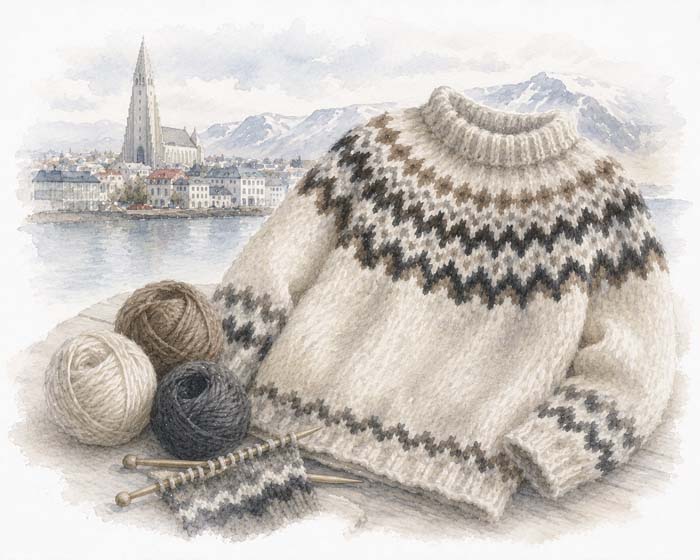
This is knitting done everywhere: at home, in cafés, on buses, by a very large proportion of the population as an ordinary skill rather than a specialist trade. There is no atelier. A sweater is worked in the round on circular needles from the hem upward, the sleeves knitted separately and joined at the underarm, and then the yoke worked as one continuous tube with the pattern and the shaping decreases happening together.
Reading a Genuine Lopapeysa
Hand-knitted work in the round has no side seams at all, because there are none to make; the body is a tube. Machine-knitted imitations are frequently made flat and seamed, so look for seams down the sides and under the arms, which a hand-knitted lopapeysa should not have. Inside the yoke, hand work shows floats of the unused colour carried across the back of the pattern, slightly irregular; machine work shows even floats or a bonded lining. The inside of the yoke is the most informative part of the whole garment.
The Yarn Test
Genuine lopi is light, slightly hairy, a little coarse against the skin, and shows visible variation in thickness because it is barely spun. It smells faintly of sheep when wet. Sweaters made from ordinary spun wool, or from acrylic blends, are smoother, denser, heavier and more uniform. The natural colours are the giveaway too: white, grey, black and a distinctive reddish brown come off the sheep, and a sweater in those tones has not necessarily been dyed at all.
Where It Was Actually Made
This is the practical question in Reykjavík. Hand-knitted Icelandic sweaters carry the marks of the association or the individual knitter and cost several times what the machine versions do, which is the clearest indicator. Ask directly whether it was hand-knitted and in Iceland, ask whether the wool is Icelandic, and treat those as two separate questions, because a sweater can be hand-knitted abroad from Icelandic yarn or machine-made in Iceland.
Undyed, and the Colours of Sheep
The classic palette is not a palette at all. Icelandic sheep come in white, black, grey and a warm reddish brown, and the traditional sweater uses those fleeces directly, sorted rather than dyed. That is why the colour combinations look coherent: they are all the same animal's range. A sweater in bright blues and reds is dyed and entirely legitimate, but it belongs to a later commercial phase rather than the original economy of using what the flock produced.
Ateliers, Villages and Artisan Encounters
Reykjavík holds the shops and the association's outlet, and the Handknitting Association is the straightforward route to a genuine hand-knitted piece. The Textile Museum at Blönduós in the north covers the wider history properly. Knitters work all over the country rather than in any one place, and a commission arranged through the association reaches a named person rather than a counter.
Wearing and Washing
Lopi is barely spun, so it pills and it fulls. A new sweater sheds and softens over its first weeks and that is normal rather than a fault. Wash rarely and by hand in cool water, because agitation and heat will felt the fabric irreversibly and a felted lopapeysa is a size smaller and permanently stiff. Dry flat. Airing it outdoors does most of what washing would, which is the traditional practice and it works.
Tourwit Editions and Provenance
Tourwit commissions directly from Icelandic hand-knitters, paying before work begins and leaving the major share of what a piece realizes with the knitter. The record names her, confirms the wool is Icelandic lopi and states whether it is undyed, gives the yoke pattern and the working hours, and states plainly that the garment was hand-knitted in Iceland rather than assembled from any one of the several plausible combinations.
Why These Works Matter
Set beside the Aran sweater this makes a clean point. Both are twentieth century inventions that became national emblems and were widely believed to be far older. Both are now outnumbered by machine copies. The difference is that hand-knitting in Iceland never became rare, so the honest description here is not of a craft rescued but of one competing with imitations of itself, which is a healthier problem to have and a rarer one in this collection.