

Craft Map
The Craft Map
Isfahan's crafts are concentrated in and around one square and the bazaar that runs from it, which makes this the most compact craft geography in the collection. Five distinct crafts are recorded here in the golden mapping, all against Isfahan, and a piece should name which of them it is rather than resting on the city alone.
Naqsh-e Jahan and the Bazaar: The Trades
The square laid out under Shah Abbas I from 1602 is both the reference for the vocabulary and the physical location of the workshops, which occupy the arcades around it and the bazaar leading north. Enamel, inlay, engraving and painting are all made within a short walk of one another and of the buildings they take their language from. A record naming Isfahan is naming this quarter, and where possible it should name the workshop, since the trades are small and the makers are known by name locally.
The Tile Kilns: Haft Rang
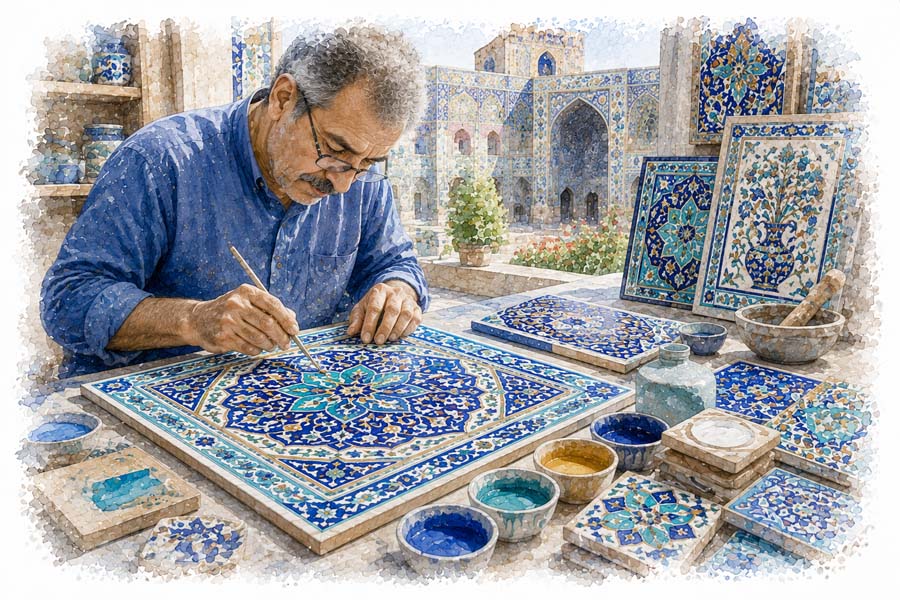
Seven-colour tilework is the craft that made the architectural programme achievable, and it remains in production for restoration as much as for new work. This matters for a collector, because a great deal of Iranian tile on the market is architectural salvage or restoration overstock rather than an object made to be owned. A tile's record should say which it is, and an honest seller will.
Shiraz and Kashan: The Wider Region
The heartland's locator reaches beyond Isfahan to Shiraz and Kashan, both of which have their own strong traditions, Kashan in tile and carpet and Shiraz in metalwork and inlay among others. These are separate centres with separate reputations and should not be collapsed into Isfahan. Where a piece comes from one of them, saying so is more accurate and generally more interesting.
The Painters' Workshops: The Isfahan School
When the court arrived, painting changed here. Reza Abbasi, who worked for Shah Abbas I and is usually called the last great master of the Persian miniature, made his reputation on single sheets for albums rather than illustrations bound into a book: one or two figures, a garden sketched in behind, sometimes gold. He preferred portraiture and the observed figure to the narrative subjects that had governed the art for two centuries. This is why Isfahan miniatures reach a collector as loose sheets, because they were made loose. A page cut out of a manuscript is a different object with a different history, and a record should say which it is holding.
The Carpet Looms
Shah Abbas moved the capital here in 1598 and established royal workshops whose designs became the reference for classical Persian carpet vocabulary. Isfahan is one of the few carpet traditions in which the workshop signs its work, a name woven into the field, and the best known of them is Seirafian, a family atelier from the 1930s that brought back silk foundations and very fine knotting. That signature makes Isfahan unusually verifiable and, for the same reason, unusually worth faking. A name in the field is a claim to check rather than a fact, and the workshop is the thing a record should carry.
The Khatam Benches
Rods of walnut, ebony and jujube, brass wire, and camel bone soaked in lime water for months to whiten it, are bound into triangular bundles and then into a cylinder whose end face shows a six-pointed star inside a hexagon. The cylinder is sliced into sheets about a millimetre thick, glued to the object and lacquered. The whole pattern therefore exists along the length of the bundle before anything is cut, which means the fineness of a piece is decided before the object it will cover is touched. Judge it by the size of the star: smaller stars mean more rods and more work.
Also on the Map
The camel bone, brass and hardwood supply on which khatam depends, and whose quality sets the ceiling on how fine a bundle can be. The copper trade behind the enamel. And the great Safavid monuments of the square, which set the standard every object in this city answers to. Which of the five crafts, and then whose bench: in Isfahan a record that answers both has done its job.