









Craft Map
The Craft Map
One nation across a territory larger than several states, one loom, and a set of design families named after the trading posts that promoted them rather than after the weavers who work them. The questions are the weaver, the chapter, the wool, the spin, the dye class and the weft count.
the Navajo Nation, Arizona and New Mexico
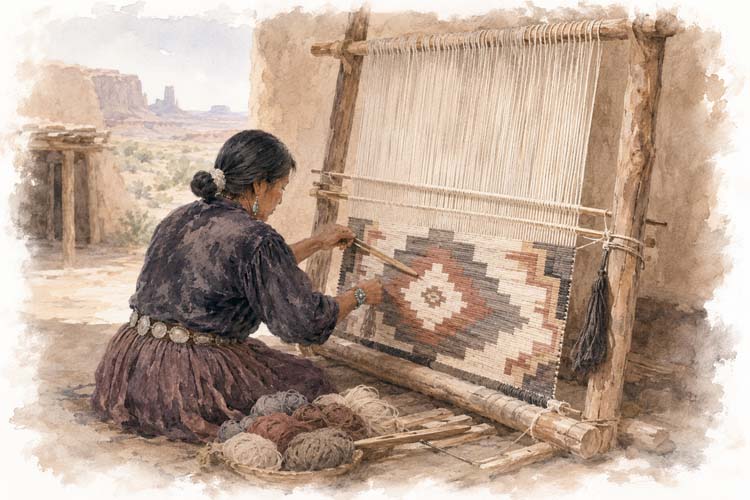
Navajo Weaving is worked across the whole territory on an upright loom warped in a continuous figure of eight, giving four finished selvedges and no fringe, with the weft beaten down by hand comb and the last inches closed by needle. Weavers work from home rather than in any workshop quarter. A record should carry the weaver's name and chapter, the wool and spin, the dye class and wefts per inch, and should not treat a style name as a statement of where the weaver lives.
Two Grey Hills and Toadlena
The fineness benchmark. Worked entirely in undyed churro wool, in browns, greys, black and white, spun very fine and set into a bordered geometry of considerable complexity. Judged on weft count above all, where serviceable work runs twenty to thirty per inch and the exceptional pieces pass a hundred, which means yarn spun to near thread and a year or more at the loom.
Ganado
Red ground with black, white and grey, the deep red so associated with the post that it carries its trader's name. The historic post still stands and operates. This is the design family most people picture when they picture a Navajo rug, which also makes it the one most widely copied abroad.
Teec Nos Pos
The densest and busiest of the families, worked in complex outlined figures with contrasting borders around each element, frequently in a wider palette than its neighbours. It carries the most visible outside influence, in that its bordered intricacy owes something to the Persian rugs traders brought as examples, and the weavers took it somewhere else entirely.
Wide Ruins and Burntwater
Banded, borderless in the older work, and dyed with the vegetal palette rebuilt deliberately from the 1940s onward in soft golds, greens, browns and rose. Burntwater added a broader range again. These are the quietest of the families and the hardest to fake convincingly, because the colours come from a dye practice rather than off a shelf.
Crownpoint
Not a design family but the counter that matters most. The rug auction here lets weavers consign directly, without a post taking the margin, into a room largely made up of people who know what they are looking at. It is the most reliable place in the region to establish that the person who wove a piece is the person being paid for it.
Also on the Map
The churro sheep, brought by the Spanish, culled to near extinction in the 1930s and rebuilt since by a deliberate breeding programme, whose lean low-lanolin fleece is what makes the yarn. Canyon de Chelly, inhabited and farmed, where Spider Rock stands. Bosque Redondo, the end of the Long Walk and the place a treaty allowed the return from in 1868. The chief blanket, banded to be worn across the shoulders rather than laid on a floor, whose pattern resolves only when the piece is wrapped. Diné silverwork, heavy and sandcast around large single stones, a separate major tradition. And the counterfeit trade running out of Mexico and Pakistan, which is the reason every question above is worth asking. The Indian Arts and Crafts Act makes misrepresentation illegal without making it rare.