The City That Sells What Others Make
It is worth being straightforward about this destination. No craft in the golden mapping originates in Delhi, and the one attached to it belongs to Punjab. Delhi's role in Indian craft is real but it is not a making role: it is the place where work from the whole of the north has been gathered, graded, finished and sold, where prices are discovered, and where the copying happens fastest. A collector needs to understand that distinction, because a great deal of what is sold in this city as belonging to it was made several hundred kilometres away. That is not a criticism of the trade, which performs a real function; it is a warning about attribution, which is a different thing and is where the losses occur.
Phulkari, and Where It Actually Belongs
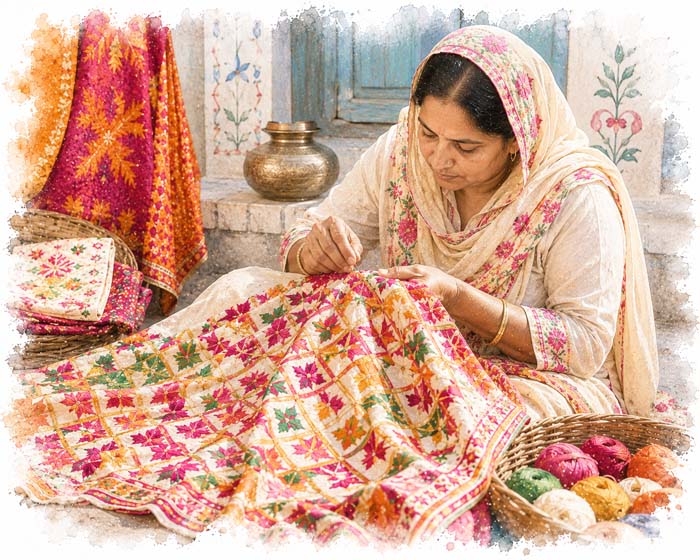
The craft is Punjabi and domestic in origin. The name means flower work, and it is embroidery in floss silk on khaddar, the coarse handspun cotton of the region, worked in long and short darn stitches counted against the weave of the ground. Because the cloth is coarse and evenly woven, the stitch can be counted rather than drawn, which is why the geometry is so regular without any pattern being marked on the cloth. Patiala is the place recorded in the mapping, and the wider tradition runs across Punjab.
The Bagh: When the Ground Disappears
The most demanding form is the bagh, literally a garden, in which the embroidery covers the entire surface so that no khaddar shows at all. A bagh was a wedding piece and represented an enormous investment of time by the household that made it. The distinction between a phulkari, where the ground is visible between motifs, and a bagh, where it is not, is the first thing to establish about any piece, because it separates ordinary work from the exceptional and it is frequently blurred in description.
A Craft Without a Court
Phulkari was not a court art and was not made for sale. It was worked by women for their own families, given at weddings, and accumulated as part of a household's textile wealth. That origin explains its most distinctive quality, which is that the designs were never standardised: there was no workshop issuing patterns and no patron requiring consistency, so regional and family variations proliferated. It also explains why the finest surviving pieces are old. When the craft became a product, the incentives changed.
What a Capital Does to a Craft
Concentration changes a craft even when the city concentrating it makes nothing. Work that arrives in Delhi is graded against work from everywhere else, which sets expectations about finish and about price that travel back to the producing regions. Designs that sell here get copied there. Formats change to suit what a market will carry, which is why so many traditional textiles are now offered in sizes their original use never required. A capital does not need to hold a craft in order to reshape it, and this one has reshaped most of northern India's.
The Patron Institution
The patron is the household, as it was with kantha in Bengal, but the circumstances differ in one important respect: a phulkari was made of new materials bought for the purpose rather than from worn-out cloth. Silk floss had to be acquired, and khaddar woven or bought. That makes a bagh a considerable outlay as well as a considerable labour, and it makes the textile a genuine holding of value in a way a quilt of old saris was not. The object was wealth, held in a form a woman could keep.
Registered Across Three States
Phulkari received Geographical Indication protection following a long application, and the registration covers Punjab, Haryana and Rajasthan rather than a single district. That is unusual and it reflects the reality of a craft that spread across a cultural region rather than sitting in one town. It also makes the mark a weaker locator than most: it confirms the tradition and the broad area, and it cannot tell a buyer which village, which household or which decade. Machine-made imitation remains widespread, and the registration has not solved it.