Arts, Crafts and Living Ateliers
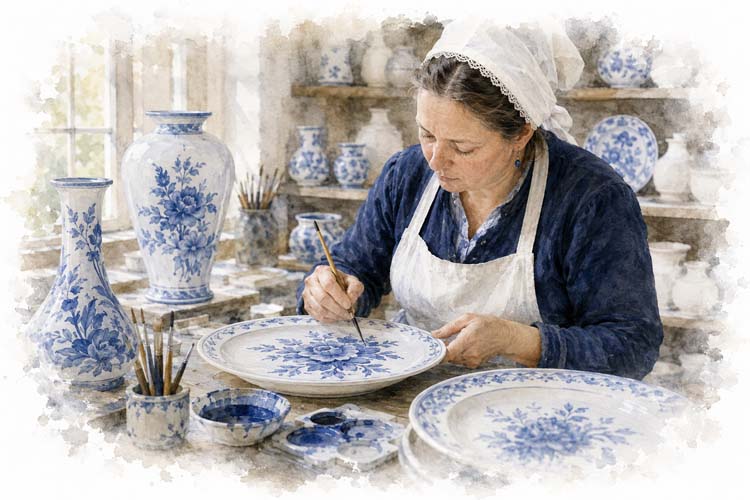
The surviving manufactory works essentially as its predecessors did: forming by throwing and by press-moulding, biscuit firing, dipping, and then the painting studio, where decorators work seated with the chalky glazed piece in one hand and a fine brush in the other. The cobalt looks grey-black before firing and only becomes blue in the kiln, so a painter is working in a colour they cannot see, judging depth by the weight of the loaded brush and by experience of what the kiln will do to it.
Reading a Delft Piece
Find an unglazed edge, a chip or the foot rim, and look at the body. Genuine delftware is buff, yellowish or pinkish and porous, quite unlike porcelain, and the glaze sits on it as a distinct layer that can flake. Hold it to a strong light: it is completely opaque, where porcelain glows. Tap it, and it gives a dull note rather than a ring. These three checks settle the question of what the object actually is before any discussion of who made it.
Hand-Painted or Printed
The commonest deception is not a fake antique but a modern transfer-printed piece sold as though it were painted. Under a glass, a print shows as a regular dot or line screen with perfectly uniform density and an edge that stops dead. Hand painting varies along every stroke, shows where the brush was reloaded, and its finest lines taper. On a hand-painted piece the same motif repeated around a rim will differ each time.
Marks, and Their Limits
The houses marked their work, and the surviving manufactory has used a recognisable mark with a dating system for a very long time, which makes its pieces unusually easy to place. That same legibility makes the mark the first thing a forger reproduces, so a mark is a starting point rather than a conclusion. The body, the glaze and the quality of the painting are harder to fake than a signature on the base, and they should be read first.
The Tiles
Delft's largest output by volume was tiles, made in the millions, and they are the most accessible entry to the tradition. Single tiles carry a small figure in a corner-framed field: children at play, soldiers, ships, animals, trades, biblical scenes. Larger tableaux assemble many tiles into one picture. Old tiles show a slightly irregular hand-cut edge, nail holes or spur marks, and mortar traces, and they are frequently a more honest purchase than a signed vase.
Ateliers, Villages and Artisan Encounters
Delft is a small canal town between The Hague and Rotterdam and can be walked in a day. The one surviving seventeenth-century manufactory operates a working pottery with its painting studio open to view, which is the place to see the raw glaze being painted. The town's museums hold historic pieces, and the Rijksmuseum in Amsterdam has the reference collection for anyone wanting to calibrate before acquiring.
Kwaart, and Why Good Pieces Shine
The clear lead overglaze applied over the painted decoration on better work is what produces the deep liquid gloss of a fine piece, and its absence is what makes an ordinary one look dry and slightly chalky. It also sinks the cobalt fractionally beneath the surface, so on a good piece the blue reads as being in the glaze rather than on it. Holding two pieces side by side under a window makes the difference obvious in a second.
Tourwit Editions and Provenance
Tourwit commissions new hand-painted work directly from Delft painters, paying before work begins and leaving the major share of what a piece realizes with the painter. The record names the painter and the house, states that the body is tin-glazed earthenware rather than porcelain, confirms the decoration is hand-painted rather than printed, and gives the date. Nothing is offered as antique.
Why These Works Matter
This is a tradition that began as frank imitation of something better and became worth having in its own right, which is a more interesting history than most crafts admit to. It also sits at the exact point where hand painting lost to industrial printing, and it lost. Acquiring a hand-painted piece today means acquiring the thing that was defeated, made by somebody who still knows how, and the honest description of that is more compelling than pretending it is porcelain.