The Savanna, Not the Forest
This is the far northeast of Ghana, hard against the Burkina Faso border, and it belongs to a different world from the Akan forest kingdoms to the south. The land is dry savanna with a single short rainy season, the settlements are dispersed compounds rather than towns, and authority historically rested with earth priests and lineage heads rather than with a centralised court. The peoples here, principally Frafra and Gurunsi and their neighbours, were never organised into a kingdom of the Asante type and were repeatedly raided by those who were. Poverty in this region is old and structural, and the basket trade is one of the few things that has moved money into it.
Grass into Cord
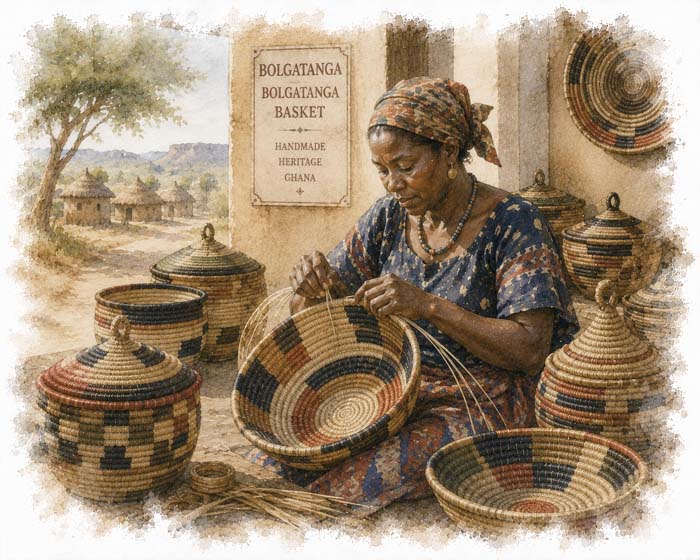
The material is a tall savanna grass, cut, dried, and split lengthwise into strips. Each strip is then twisted into a two-ply cord, done by rolling it along the thigh with the palm, which is the slowest part of the whole process and the part that never gets mechanised. Dyeing is done to the cord rather than the finished basket, so the colours are integral. Before weaving, the cord is soaked, because dry grass snaps and wet grass can be hauled tight into the dense interlock the form depends on.
Weaving Without a Mould
The base is started flat and the sides rise from it as tension increases, with the weaver working around and pulling each round hard into place. Nothing supports the shape from inside. A skilled weaver produces a vessel that is symmetrical, evenly dense from base to rim, and resilient, and the finished basket can be flattened for transport and will recover. The handle is usually wrapped in leather at the end, which is a separate trade done by tanners.
Colour Before Weaving
Dyeing is done to the cord, not to the basket, and that ordering is what makes the patterns possible. A weaver assembles a palette of dyed cords first and then builds the design as the basket rises, counting rounds, which means the pattern has to be held in the head from the base upward with no opportunity to correct it later. Historic colour came from local plant and mineral sources in a limited range; most current work uses commercial dye, which widened the palette enormously and is the single biggest visual change the craft has undergone.
The Patron Institution
There is no court behind this craft and there never was. It grew as a domestic technology, baskets for carrying grain and produce and for household storage, and it became a cash trade during the twentieth century when the form found buyers first in Ghana's south and then abroad. The absence of a patron is the defining economic fact here: there is no guild, no closed lineage, no hereditary restriction, and consequently a very large and open population of weavers, most of them women, working from home.
A Dry-Season Economy
The rains here fall in one block and the rest of the year is dry, which leaves a long agricultural off-season. Basket weaving occupies it. That seasonality shapes everything downstream: supply is concentrated, quality varies with how urgently a household needs cash, and the export orders that arrive out of season have to be met by people who are also farming. It is genuinely a second income for most of the people making these, not a full-time profession, and understanding that explains both the scale of production and the variability of what reaches the market. A weaver with time produces a tighter basket than a weaver who needs the money by Friday, and both go into the same stack.
The Price Problem
Because the trade is open and the weavers are many and dispersed, the bargaining position of the individual maker is weak, and a basket that sells for a substantial sum in Europe or America may have left the weaver's hands for very little. This is the central ethical issue in the craft, more so than authenticity, which is rarely in doubt. Several cooperatives and direct-purchase arrangements exist specifically to address it, and the difference they make is measurable at the household level, in school fees and in roofing. It is one of the rare crafts where the ethical question is entirely about price and not at all about authenticity.