Arts, Crafts and Living Ateliers
The techniques are the direct ones: melting, casting into simple moulds, hammering, rolling to sheet, cutting, chasing, punching and linking. There is no filigree tradition here and very little soldered assembly; pieces are built from plates and links joined mechanically, which is why Mapuche silver has its characteristic weight and its slightly austere flat surfaces. The work is done at a small forge and a bench, and the finish is deliberately plain by the standards of colonial silver. The aesthetic is not a limitation of means but a preference, and it is what makes a piece recognisable across a room.
Reading Mapuche Silver
Weight and construction come first. Historic pieces are made from melted coin silver and are noticeably heavy for their size, with plates of real thickness and links that are individually formed. Look at the chasing and punchwork: the decoration is struck into the surface with punches rather than engraved or cast, and on old work the marks vary slightly because each was a hammer blow. Cast reproductions show softened, uniform detail and are lighter. Look also at wear, since these were worn on the body and genuine pieces show it at the suspension points.
The Forms and What They Mean
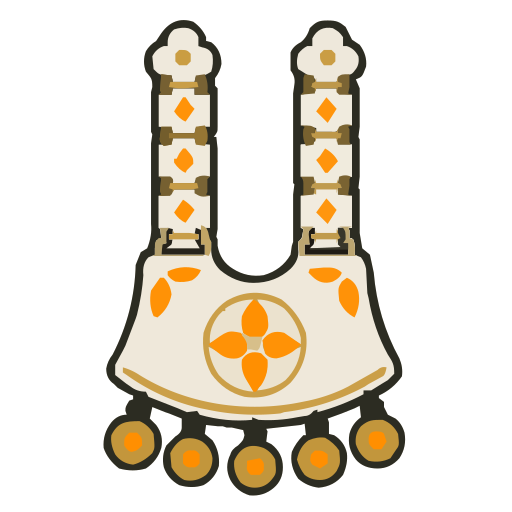
Learn the names, because they are the fastest route to understanding a piece. A trarilonko is for the head, a trapelakucha for the chest, and the various pins fasten dress. The forms are not interchangeable ornaments; they belong to positions on the body and to occasions, and a set was assembled over time rather than bought at once. A seller who can name a form correctly and say what it fastened is a different proposition from one selling generic Andean silver.
The Antique Market, and Its Sources
A large volume of nineteenth-century Mapuche silver is in circulation, and its route out of Mapuche hands is usually the poverty that followed the loss of territory. That is not the same ethical situation as the Bolivian ceremonial textiles, since these were personal and family property rather than communal, and they were generally sold rather than stolen. But the sales were made under duress of a kind, and a buyer should hold that fact rather than treat an antique trapelakucha as a neutral object.
Why It Is Coin Silver
The material has a practical consequence that shows in the objects. Coin silver is alloyed for durability rather than for working, so it is harder than the sterling a European silversmith would expect and it behaves differently under the hammer. It also means the composition varies with whatever coins went into a given melt, which is why the colour and the tarnish of historic pieces are not uniform. A piece of perfectly consistent modern sterling in a traditional form is a modern piece, honestly or otherwise described.
Ateliers, Villages and Artisan Encounters
Contemporary Mapuche silversmiths work across the Araucanía and in the cities of southern Chile, and the revival has produced both careful traditional work and contemporary interpretation, frequently by Mapuche makers who are explicit about which they are doing. Temuco is the regional centre and the practical way in. As always, the distinction worth establishing is whether the maker is Mapuche, because a great deal of Mapuche-styled silver is not, and the question can be asked directly without giving offence.
Tourwit Editions and Provenance
Tourwit works directly with Mapuche silversmiths in the Araucanía rather than through intermediaries. Artisans are paid before the work begins and retain the major share of what a piece realizes. Editions are limited by what a forge and a bench can produce, and each work is documented at source with its maker, their community, the form by its Mapudungun name and whether the piece is traditional or contemporary in intent, so that the record travels with the object.
Why These Works Matter
Here is a body of work made by a people who were never conquered while they were making it, out of the money of the states that were trying to absorb them, worn by women as a public statement of exactly who they were. The peak of it falls in the last decades before that independence ended. Very few crafts anywhere carry their own political history so legibly in their material, and understanding where the silver came from is not background to these objects. It is the objects.