Whakapapa
Everything here rests on genealogy. Whakapapa is the layered account of descent that connects a person to their hapū and iwi, to the land, and back to the first ancestors and the atua, and it is not a metaphor or a family tree in the European sense. It determines rights, obligations and belonging. A carving, a cloak or a piece of pounamu sits inside that framework and carries the relationships it records, which is why these objects are not straightforwardly property and cannot be treated as though they were.
Whakairo: Carving as Ancestor
Māori carving in wood, bone and stone renders ancestors, and the figures in a meeting house are specific named people, not types. A wharenui is understood as an ancestral body: the ridgepole its spine, the rafters its ribs, the facing boards its arms, the carved figure at the apex its face. To stand inside is to stand within an ancestor. The surface patterning, spirals and interlocking forms cut in relief, belongs to identifiable regional styles.
Who May Carve
Carving was traditionally restricted, taught within whānau and under tapu, with rules about the workspace, about food near the work, and about the disposal of chips. It was men's work as weaving was women's, a division that has loosened but is still widely observed. Training now runs through iwi and through institutes including the national carving school at Rotorua, which teaches to regional styles rather than a single national one.
Pounamu and the Law
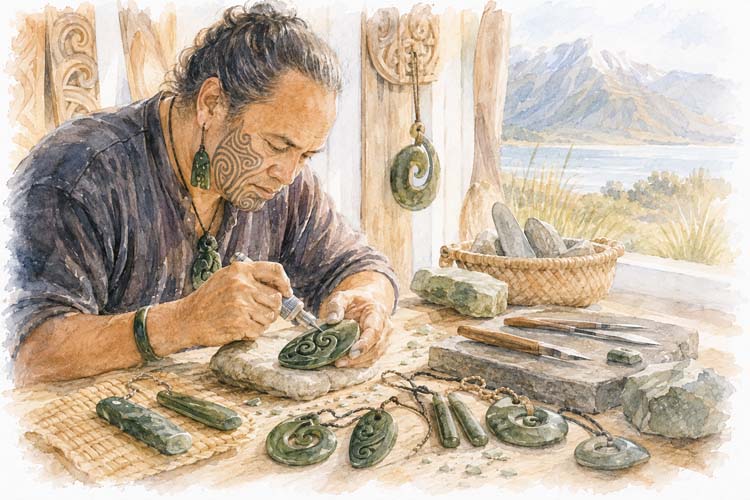
The greenstone of the South Island, nephrite jade, was the hardest material available to Māori and made adzes, chisels, weapons and the ornaments that are now its best-known form. It is also the subject of a specific legal settlement: ownership of all naturally occurring pounamu in the South Island was vested in Ngāi Tahu in 1997 as part of Treaty redress. That is a statutory fact rather than a custom, and it governs who may take it and sell it.
Working Stone Without Metal
Nephrite is extraordinarily tough, resisting fracture better than most stone, and pre-contact working was done entirely by abrasion: sawing with slabs of sandstone and water, drilling with a cord-driven point and grit, grinding and finally polishing over long periods. A large adze represented months. Modern work uses diamond tools, which is not a deception but changes the labour entirely, and the distinction between abraded and diamond-cut work should be stated rather than left to be assumed.
Raranga and Harakeke
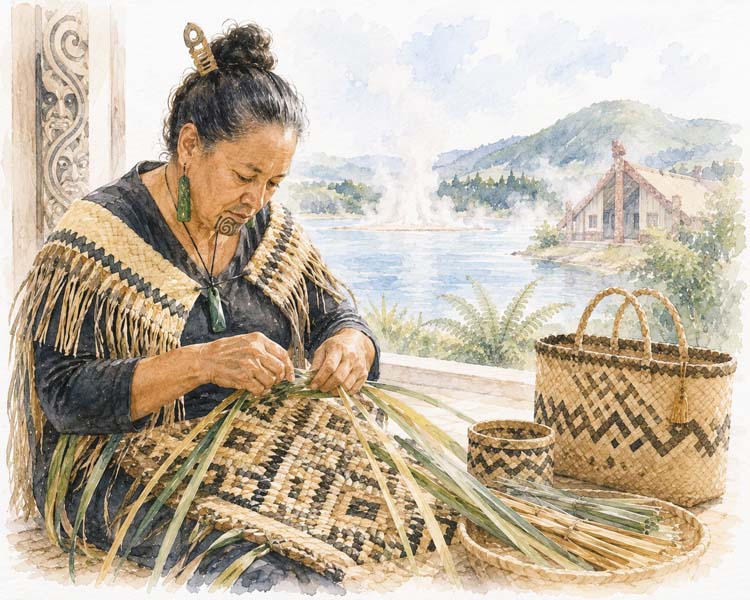
Weaving uses harakeke, the New Zealand flax, which is not flax at all but a lily with long strap leaves. Leaves are selected and cut according to protocol, stripped, and the fibre extracted by scraping with a shell; it is then softened, dyed and woven. From it come baskets, mats, and the cloaks that are the tradition's highest form, some feathered, some of finely twisted fibre with woven borders.
Cutting Rules
The protocols around harakeke are specific and still kept: the central shoot and the two leaves either side of it, understood as the child and the parents, are never cut; cutting is done downward and outward; weaving is not done at night or with food present; and the offcuts are returned to the plant. These are not superstitions attached afterwards but the operating conditions of the craft, and weavers will correct a visitor who breaches them.
Taonga, Not Property
The word that matters is taonga: something treasured, held in trust and carrying the mana of those it belonged to. A cloak or a carving is understood to accumulate the presence of the people who have worn or held it, which is why such things are conferred rather than sold, are named, and return to a family. It is also why the return of taonga from overseas museums is a continuing and serious matter rather than a symbolic one.
Where It Stands
All three are in genuinely strong condition, which is not the usual finding in this collection. The Māori cultural renaissance from the 1970s onward rebuilt language, marae and craft together, carving and weaving are taught formally and practised widely, and the objects are used rather than displayed. The live issues are appropriation, the sale of imported jade as pounamu, and mass-produced carvings made offshore and sold at airports.